Showing posts with label what can we do? green. Show all posts

Thursday, March 27, 2014

bottled water: just say no!

There was a point in my past life when I bought a case of seltzer water a week. I developed the habit during graduate school when I felt perpetually ill from stress, lack of sleep and too much caffeine. Bubbly water seemed the only antidote to the buckets of bad coffee I drank to stay awake.

I traded the caffeine (and the stress) for more sleep when I graduated over a decade ago. But my habit of drinking seltzer water continued for several more years.  Then one day I looked at my recycle bin and noticed the way it overflowed with empty plastic. Why hadn't that bothered me before? Deciding that was way too much plastic for any one person to produce in a week, so I resolved to quit the habit. 

I still drink seltzer, but instead of buying twelve plastic bottles each week, I buy one or two glass bottles instead.

Just a week ago, if you'd asked me if I drank water out of plastic bottles, I'd have said "no way!" I wonder if my feelings of self-righteousness would have showed through. With the exception of "rare occasions" when a plastic bottle of water seemed unavoidable, I did not see myself as part of our growing bottled water problem. 

Then last weekend, we watched the documentary Tapped.  Have you seen it? It skewers the bottled water industry at every step of the product cycle: from extraction, where beverage companies haul water away from local communities who don't share in the profits; to packaging, where manufacture of the bottles relies on petroleum and harmful chemical elements (BPA when the film was made, antimony now); to testing, which is overseen by one FDA employee; to advertising, which misleads consumers into thinking the water is safer than tap water; to disposal which is turning our oceans into a "plastic soup."

After watching it, you'll vow to never touch another bottle of water again. That's what Steve and I said anyway. Of course, I was thinking in my I'm-already-all-over-this way about how I gave up bottled water years ago, but I didn't say that out loud.

The next day, I went to the coffee shop to work on my book. I don't do this every day - maybe once every one or two weeks.  After a long morning drinking decaf and writing, I decided I needed something to eat.

And I was thirsty.

I looked at my drink options: plastic bottles of water, plastic bottles of soda, and glass bottles of juice. 

I hesitated. I couldn't drink a bottle of water the day after watching Tapped! But I hate juice, refuse to drink soda (it's in plastic anyway) and couldn't stand the idea of another sweet drink after all the coffee I'd had (I'm not a black coffee kind of girl).

What should I do? I could hear the people behind me shuffling their feet in line. Their looks of "make up your mind!" drilled into the back of my head as I tottered on the edge of a panic-purchase.

My mind raced. I didn't have a reusable water bottle with me, and besides, would it be fair to bring my own drink after sitting in this restaurant using their electricity and wifi all day? I felt like I owed the proprietors my business.

So I did it. I pulled a crinkly bottle of water out of the ice, purchased it, and drank it. The day after watching Tapped.

Just this once.

Two nights later, I co-hosted a team-dinner for my son's soccer team. The other family provided drinks: two cases of water and a case of Gatorade. Egad! That was more water bottles than I wanted to be responsible for in a year!

An hour or two into the evening, I offhandedly mentioned how thirsty I was to Steve. The other mom heard me and kindly brought me a bottle of water. "Oh, thanks!" I said with a pained smile. I didn't know what to do. Could I sneak through the living room, return the bottle to the cooler, then rummage through her cupboards for a glass without her noticing? And would it matter if I did? Someone was going to drink that bottle of water, whether I did or not.

My friend stood in front of me, expecting me to guzzle down this drink with relief. Not wanting to be rude, I twisted off the plastic top with a crackle, and drank up.

Later, I noticed Steve doing it too.

Just this once.

Three days later, I volunteered to help out at my daughter's swim meet. I brought a reusable water bottle with me because all-day meets in hot indoor pools never fail to dehydrate me. In the afternoon, I sat at the scoring table entering meet results into a computer. Toward the end of the meet, things became frenzied as we worked to finish the events on time. I had drained my water bottle long before. Parched, I asked a swimmer if they could refill my bottle at a water fountain. Before I could stop her, another mom intercepted, explaining there was no need to do that because "We have a whole cooler of water bottles right here!" She was nice enough to bring me one.

And I drank it.

Just this once.

"Just this once" turned out to be three bottles of water within one week of watching Tapped!  That's hardly a record of abstinence.

If I were in high school trying not to get pregnant, I'd be in big trouble.

I still feel completely committed to the idea that I should never drink or purchase a bottle of water again. What I discovered, however, is how much our culture has acclimated to this idea of portable water. With bottles so omnipresent, other ways of accessing and drinking water (like large thermoses, pitchers and, imagine: CUPS!) have disappeared.

I'm sure I'm not the only person who watched Tapped and swore myself off of bottled water. And I bet I'm also not the only person to discover this can be a challenge.

As a country, we consume bottled water like it's...well...water. Check out the numbers. Between 2009 (when Tapped came out) and 2012, sale of bottled water increased by 1.2 BILLION gallons!
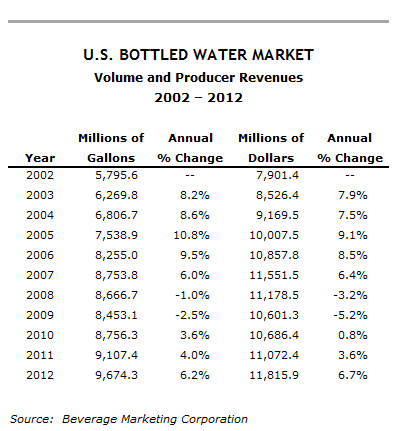


For the visual effect:
Data from the Beverage Marketing Corporation. Graph by Peter Gleick


The International Bottled Water Association (IBWA) cited a bright future for bottled water sales last spring, noting a 6.2% increase in bottled water consumption between 2012 and 2013.  According to IBWA, U.S. consumption rates work out to an average of 30.8 gallons of water per person per year!

But there's good news for conservationists too. San Francisco just banned the sale of bottled water on public property. How cool is that!?  As part of the ordinance, the city will also take steps to provide more "water filling stations" around town.  At least in San Francisco, public water won't go the way of the public phone.

While San Francisco marks the first major city to ban bottled water, smaller movements have led the charge. Concord, Massachusetts became the first city to implement a ban when it did so on January 2013. That same month, the University of Vermont became one of the first public universities to implement a ban on bottled water sales.  The movement continues to grow with other smaller communities and private universities getting on board. In the latest news, Western Washington University will remove bottled water from campus shelves in just a few days, on April 1st.

If you want to learn more about the movement to ban bottled water, check out the blog Ban the Bottle.

As for me, I'm regrouping. Over the past week, I discovered that really giving up bottled water is not a passive thing. I had no idea the "rare occasions" when I drank bottled water were so frequent. All of my nice friends and acquaintances caught me off guard with their kindness and generosity.

But now I'm ready for them: "Thanks so much, but I've given it up." It's as simple as "Just Say No!" If anyone asks why, I get a chance to spread the word.

So many world problems feel impossible and expensive to solve. This one is so easy.

In the U.S., public water is safe and free.

All we have to do is drink it!


Friday, December 28, 2012

xmas wrap up

I had this fab plan to wrap all of our xmas presents in newspaper this year.  Wouldn't it be great? I reveled in how we'd avoid that mountain of wasteful shiny, non recyclable paper that always depresses me so much in late December. 

I announced my plan with unbridled enthusiasm, as if I were declaring "double presents for everyone!" But immediately, I sensed dissension in the ranks. 

Nobody actually said anything, but Steve wrapped A LOT of presents before I could get to them.  He scampered around like a squirrel before winter, stashing everything under cover of one very under average Santa-faced green paper that we had leftover from last year. I didn't complain. I understood that all that paper was headed for the dump anyway, no matter what path it took, so why not let it detour under our tree?

Steve wasn't the only dissenter.  Gareth, in typical teen detachment, didn't even know about my plan until Christmas eve when he reacted with a simple and somewhat disdainful, "What?!"

Olivia, on the other hand, knew from the beginning, and like her father, held her tongue.  When faced with the curled and oblong remnants of paper discarded by her father, she quietly took a piece of newspaper from the pile I had so happily provided.  Can you see me? I'm sitting with hands folded, watching with beaming anticipation to see what she'll create.  As I looked on expectantly, she rolled her father's new Redskins hat up in grey print, scribbled a haphazard purple heart on one side, then tossed the mediocre results carelessly under the tree.

Did I sense an element of resentment there?

Sometimes I really feel like the Grinch, tap tap tapping my long and greedy nails on the table top as I think up new ways to rob my innocent little Whos of their cherished Christmas traditions.  I can hear Olivia-Lou-who now, "Mommy why, why are you taking our wrapping paper, WHY?"

Why?  Well, I just cannot take things at their surface value alone.  I like this about myself, but I know that it sometimes makes me a really annoying person to be around.  I regularly ruin movies while we're still in the middle of watching them, and you know I'm a nightmare on a shopping trip.  It doesn't stop there.  For example: we saw a lit up polar bear in someone's yard the other day. It looked something like this one:


Olivia said, "Awww.  How cute!  Look at the polar bear!" 

Since it was Christmas eve, I figured it was my turn to hold my tongue, but truth be told, I didn't see "cute," I saw this:


And I thought: "Wait.  We're burning fossil fuels to light up a plastic polar bear at a time when the burning of fossil fuels has caused warming dramatic enough to have drowned baby polar bears at a rate of approximately 45% because the sea ice that allows them to rest and feed during long swims has melted due to the burning of carbon-emitting fossil fuels used to (we're coming around full circle here) light up things like this stupid plastic polar bear that, instead of speaking to us about how to save the baby bears, delivers a 'Merry Christmas!' message during a holiday season that's supposed to be centered around the hope of new birth?" 

Yes, I can't stop this paradoxical rant from prattling around in my head as I drive with my family over the river and through the woods to grandmother's house for dinner on Christmas eve.  No matter how you light him up, a polar bear is a polar bear, and I just cannot turn that off. 

So sure, flashy presents look beautiful and festive under the tree.  But to see that, and only that, you have to ignore the trashy truth beneath: that most wrapping paper cannot be recycled, that half of the paper Americans use in a year goes to wrapping gifts, and that household waste increases by 25% between Thanksgiving and New Years with trash from wrapping, packaging and shopping bags, food waste, bows and ribbons creating 1 million extra tons of trash per week (source).   The Carnegie Mellon Green Practices Initiative claims that "if every American family wrapped just 3 presents in re-used materials, it would save enough paper to cover 45,000 football fields."

Forty-five thousand football fields? You had me at "one." 

Since I cannot unlearn stuff like that, I persisted with Grinching up Christmas for my poor little Who family.  I hoped that perhaps I would inspire them with my "beautiful" recyclable creations. 

I felt intent on my purpose, but I didn't expect to have so much fun carrying it out.  I've said before that I break into a sweat at the word "craft," and nothing can clear me out of a room faster than the three letters DIY.  In a doltish sort of way, however, I always enjoyed coloring as a child.  How lucky that wrapping with newspaper turned out to be just that sort of job--but with the added interest of words

Since an article about drone strikes doesn't make good packaging, I found myself searching the Style section and the Sports page for fun headlines and pictures, then coloring them in for what my mother would call, "a little zing." 

Ensconced in our bedroom on the afternoon of Christmas eve, I lost myself in the task.  Steve came looking for me at least an hour later and found me sitting on the bed like a child, surrounded by cut up newspapers, a mountain of broken crayons, and an array of green and red markers.  I actually felt embarrassed.

"What have you been doing in here?" he asked with exasperation.

"Coloring," I said sheepishly, putting down my crayon.

I'm no artist, but I was proud of my creations anyway.  And since the fam knew I worked so hard on them, no one complained about the newspaper under the tree. I think (hope) they appreciated the effort, if not the cause.

Some results:

this gift for steve featured a Redskin returning a ball for a touch down.
no, i have no idea who he is, but steve knew, which is all that mattered.
 

the front of the post featured
 this mystical wintry picture of reindeer pulling a sled.
i admit i didn't read the article.  i hope it wasn't about something
dreadful like disappearing ice


an advertisement
offered a rare full page of solid red - a gold mine!
(i glued the picture of notes & shopping bags to the front for Olivia, our musician)


this picture of blinds made for some cool horizontal lines
on this masculine package for Gareth - and the ad even said "warm wishes"
Other packages featured Gareth's favorite Maryland Terps scoring a basket, a sports headline about "getting the ball rolling" on a package that contained juggling balls, and a color picture of a sustainably powered house (appropriate, right?). 

the lot of them
 
In the end, as I began to grow tired, I slapped a random paper onto a gift for Olivia without really looking at the articles. When I turned it over, only two words of the bold-faced headline had wrapped around to the front: "gratitude" and "unite." I couldn't help myself: I took it as a sign. 

"Gratitude" - a reminder to be grateful for what we have, of course.  But since the word appeared just as I finished wrapping, I also took it as a thank you for my recycled wrapping job. 

And "Unite" -  the inspiration to write this post and ask others to unite in using recycled or reusable packaging for gifts.  I really don't know if we can save the polar bears, but I do know that together we can at least save 45,000 football fields worth of paper.  That has to be worth something.

And what of my tortured little Whos?  Of course you know that Christmas "CAME."  "Somehow or other, it came just the same!"

--------------------------------
The holidays are winding down, but it's not too late to get started.  Here are some alternatives to wrapping paper we can experiment with throughout the year.

 - old maps
 - old newspapers/comics/magazines
 - recycled and/or recyclable wrapping paper
 - if you can sew, DIY cloth gift bags (thanks for the link thalassa!)
 - purchasable cloth gift bags/decorative boxes (I'll let you google it rather than tell you what to buy)
 - reusable tins
 - cloth ribbons and bows
 - twine
 - recycled gift wrap and bags that you salvage from gifts you are given

Feel free to share if you have other ideas!

Friday, December 21, 2012

solar lights: what the season can afford

image from www.efergy.com
We bought ours from www.outdoorsolarstore.com
They didn't have good pictures!


In my quest for a green Christmas, we bought solar powered lights for the house last month.  I'd never heard of them until a blogger friend, thalassa, suggested it last year in response to my post on a smaller christmas.

I really did not know what to expect from them.  They earned rave reviews the caliber of "they last all night long!" on Amazon, but I took that with a grain of salt.  As it turns out, I should have taken it with the whole shaker because I'd say they only last for about an hour or two a night.  If you want to stop by for some Christmas cheer, you better do so around dusk.  It's pretty much lights out after that!

I could complain and say they weren't worth the $70 we paid for them, but you know I'm not going to do that. 

First, how cool that we have solar panels (no matter how small) in our yard!  I feel so liberated by that.  Turning on lights without plugging them in feels a little like biking downtown without the fetters of a car.  I love that feeling of being unattached.  Plus, I so appreciate having this technology around for the kids.  We've taken something abstract and futuristic and made it tangible--possible--real.

Except for this pesky problem that they don't work very well. 

Egad.

Here's the thing, however:  no one seems to be very disappointed by that.  Sure, it'd be nice if the lights gave us just an hour or two more, but we don't seem to want that badly enough to switch back to electric.

I don't know about the rest of the family, but our solar lights have grown on me in part because they aren't faulty.  They would work perfectly well if the sun wasn't so shy at this time of year.  It cloaks itself with a thick winter blanket of clouds and fog, leaving us out in the cold and dark at a time when we need it's warming rays the most.  It has only shown itself for one day since we put the lights up, and even then it turned its face bashfully toward the horizon the entire time. 

Such cowering would never happen mid-summer when the sun's lofty perch emboldens it to stare directly at us with a sometimes punishing gaze.  I know we would have no problem capturing that look and shining it back "all night long" if it were July. 

But it's not July.  And that, my friends, is one of the points of Christmas lights to begin with, isn't it?

December leads us, no matter what our faith, into darkness.  Think, in ancient times, how despairing people must have felt as the sun sunk lower and lower in the sky.   What better way to ward off this despair than with festivals of food and light?  From the yule log, to the menorah, to the star of Bethlehem, to the candles of Kwanzaa, we can find light at the center of faith traditions in December.  Festivals bring hope and cheer in the face of despair.  And there is reason to hope because, once you've come to the shortest day of the year, you know the next day will be longer.  In that sense, the solstice marks a corner of hope for everyone in December. 

To use solar lights as part of our celebration, however, presents us with a paradox.  We need the lights to cheer is in our winter darkness, but that darkness dims the lights.  On the surface, it doesn't have the makings of a great plan! 

Yet the lights inspire.  More than symbolic, they literally reflect the power and light of the sun back to us.  They can only give us what they've received, and in so doing, they manage to extend our shortest days for a few lovely hours before their flicker turns to fade.  In contrast, the ultra bright lights that do shine "all night long" feel almost obscene--like a display of excess during a time of scarcity. 

Earlier in the month, I envied those excessive displays, but over time, I've come to appreciate our meager showing for its seasonal rhythm and its lessatarian leanings.  It offers only what the season's light can afford. 

And we've discovered that's enough.

Friday, October 19, 2012

election fatigue? take a spoonful of fall

 
this perfect (but inedible) pumpkin volunteered in my herb garden this year

Fall is well upon us, and not a word from me.  That just shows you the power of Mitt Romney to distract, because I love this time of year, and I haven’t been enjoying it nearly as much as I should. 


Even though the election has distracted me from the more introspective aspects of the season, I have still been incredibly busy with the preparation that October requires.  I have tomatoes, beans and fruit put up, herbs drying, and green stuff like broccoli, kale and collards moving weekly into my freezer. 


out of focus - i couldn't hold my camer still while standing on a chair!
 
the new word in window treatments!


boring apple picture
 
If I must have gray hovering around my doorstep in just a few weeks, at least I know I have color bottled up in jars, boxed up in cool storage, and vacuum packed in my freezer.  Meanwhile, we'll make the most of the arugula that's prime in the fridge, dappling it with walnuts and pear from the market.  We know the salad won’t last, but we don’t dwell on it.  There's something deeply satisfying in the box of pale fleshy sweet potatoes that stands a hero’s guard against winter in the corner of my kitchen.
 
An even surer sign of the season, we had soup for dinner last night! Black bean: the first official soup of these coming cooler months.  
 
As it happens, I have a confession to make about those beans. 
 
Remember when I posted Earth:Full, Pantry: Empty?  Well, feeling that the bar of soap I bought might make an inadequate store for civilization's coming seige, I eventually ordered some beans. 
 
Yes.  Yes, I did. 
 
You see, I already order wheat in bulk because I grind it to make my own flour.  So it wasn’t a stretch by any means to venture into the bean section of the website and click the number “one” under the description “black beans-6 gallon bucket.”  

Then I forgot about it.  Imagine my surprise when the order came in six weeks later.  I opened my bucket of “wheat,” only to discover a surprise guest:  a mountain of black beans, all shiny, new, and expectant. 
 
Six gallons.  I think that amounts to about 96 cups of beans (94, if you subtract what I used for the soup).

Steve doesn’t know. 

If you live in a small house, how do you hide 96 cups of black beans from your husband?  
 
You put them in the laundry room and stack other stuff on top of them.  Then you hope he doesn’t trip on the bucket when putting the bath towels in the dryer.  While he’s there, you might as well cross your fingers that he doesn’t look in the freezer, because you probably haven’t yet told him about the chickens…

Other women hide new stuff like Jimmy Choo pumps or Prada handbags.  Me? I don't really even know what those things are (I googled "fashionable shoes" to find cool names).  I have 6 gallons of dried beans lurking in my laundry room and approximately 20 covert chickens stuffed into a “new” freezer we inherited from my parents. 

It’s not that Steve doesn’t know that I store our food for winter.  It’s just that I don’t tell him about the bill when it happens (if he was a more faithful reader I could worry about outing myself but…that’s not a problem!).  It’s OK.  The cost will work itself out later, in the minimal grocery bill we’ll enjoy all winter.  For now, I plan to stay mum on the chickens and play oblivious to the beans.

Meanwhile, I need a break.  I think I have food storage fatigue.  I know I have election fatigue.  And I'm missing the fall. 

So tonight we went for a walk.
 
steve and my block-headed
but lovable dog named Maybe


posing


The in between seasons teach us to pay attention, because whatever pleasures they offer, are fleeting.
 
a bee showing up for "last call"

Winter and summer can drag on.  Too much snow gives us cabin fever; too much sun gives us heat stroke.  The extremes wear us out, and by the end, we appeal for change. But not so with the in between.  I mean, when was the last time you heard someone say they were tired of fall?  Or sick of spring?  
 
a pink mum
 
summer marigolds still hanging on
 
In the moderate temperatures of fall, we can stop sweating and sit back to watch and listen as a timpani of clouds rolls in over the fiery hills, a trumpeting wind blusters leaves into fountains of sky, and color comes oozing out of the planet like music.  
 
decay is part of the beauty of fall
 
But be sure to tune in.  If you get distracted, you'll miss the show. 

Tuesday, July 3, 2012

earth: full, pantry: empty


Like a lot of folks, I’ve read and watched some scary stuff about our economy and the environment in recent years. We face a warming climate, overpopulation, crippling trade deficits, a seemingly insurmountable national debt, peaking oil and water supplies, and a food production and distribution system that depends on all of these other at-risk factors to keep our rumbling bellies full. It’s too much to think about, really.

And so we don’t.

Deer in the headlights? Ostriches with our heads in the sand? Or perhaps a creative double-jeopardy-kind-of-combination never before seen in the history of denial: we have our heads in the sand and our asses to the headlights: doomed, paralysed, and willfully ignorant.

Before I crush you with negativity, grab yourself a beer, a coffee, or perhaps a tub of ice cream, and watch Paul Gilding’s fairly optimistic TED talk The Earth is Full. Or if you prefer, you can read an interview with him about his book The Great Disruption. Or, egad, read the book itself! (I haven’t yet).

Gilding is a genius. Not for his science, not for his research or business acuity, not for his synthesis of information.

For his attitude.

He somehow argues that when the poor abused fan we call earth spins into the imminent shit storm of ecologic and economic calamity he predicts, we will have our finest hour. 

Gilding contends that not only is the earth warming, it is full. He cites the Global Footprint Network to argue that it takes 1.5 Earths to maintain our global economy in its current state.  Add that we expect the population to quadruple by 2050 and things look dire indeed.

If that's not enough, there's a catch-22.  While we need to reduce our rates of water consumption, CO2 emissions, and soil degradation to sustain the earth, we need to increase these things to sustain the economy.

With our present methods, we cannot do both.

Don't worry.  That wasn't the positive part.  This is:  Gilding argues against despair.  From a position of hope he claims humans are good in a crisis.  We are innovative, possess an incredible capacity for change, and when pressed, repeatedly come together to achieve "whatever it takes" with speed and efficiency.

Reading this, I feel like a child getting a pep talk from my mom.  Yes we can!

He admits that there will be pain and suffering in our lifetime, possibly even a collapse of our civilization, but ultimately, Gilding argues, we will come through it for the better ("it won't hurt" says mom at the doctor's office, "you'll just feel a little pressure").

I appreciate the positive angle, and I see how Gilding’s attitude makes his rather devastating news more digestible.

But I can also read between the very wide lines. System collapse means empty shelves at the grocery store, no gas at the pump, water scarcity, heat, and cold.

In the worst case, we’re using dollar bills for toilet paper (now that’s going green!) and defending our meager vegetable plots with stolen guns that we don’t know how to use.

Sitting alone at my computer in the dark of night, bleary eyed in my Twitter Haze, I got a little scared. Shouldn’t we prepare for this coming-apart-at-the-seams? I mean, what will it take to be one of those upbeat innovators who comes through the “pain and suffering” part to enjoy the new sustainable world? When the Care Bears flit around on wind turbines, bounce carelessly from solar panel to solar panel, and slide giggling over the arches of renewable rainbows, I want to be there.

And who can I talk to about this desire, these fears?

Even though the naysayers repeatedly discredit themselves with faulty research and ad homonym attacks on credible scientists, their noise creates uncertainty for lay people like me who are unschooled in the details we need to fully understand what's going on.

Let’s face it. Nobody wants to be called Chicken Little, and anyone who talks about societal collapse and catastrophic climate change in the mainstream takes that risk.

I checked Gilding’s credentials and those of the sources he cites. Very solid. And to be truthful, a lot of this wasn’t new to me. I read Storms of My Grandchildren by NASA scientist James Hansen. I read The Long Emergency by James Howard Kunstler. And besides, it doesn't take a rocket scientist, or a climate scientist for that matter, to understand that we cannot create infinite economic growth on a finite planet. Period.

I decided I'd rather be safe than sorry. I would collect necessities, but secretly. No one would have to know.

Why secretly?

Because I'd rather be a big chicken in private than Chicken Little in public.

Pathetic, I know.

So surreptitiously, I set out for the grocery store with a mission: save myself, save the kids, live to see the future! Then I got overwhelmed. How do I store months’ worth of water for four in a “small house” without anyone knowing about it? Where would I put all those canned goods? Will we have to eat them before they spoil if the sky doesn’t fall? Blech! How often do I replenish? (that’s expensive!).What about other necessities like tampons, band aids, BAKING SODA?!  The list started to explode.

In the end, I came home with an extra bag of rice and three bars of soap.

It’s true. I don’t shop well in a crisis.

So bring it on: resource wars, floods, starvation, dehydration, gun fights in the potato patch:

We'll be lathered and ready.

How about you?