The applesauce is in the pot cooking down. I'll can it later, and then, I just might put the canner up for the season. But you never know.
It's getting to be that time of year - when the fall crops come in and the frenzy of canning and freezing food goes out. You gotta love winter squash and root vegetables. All you have to do to preserve them is put them in a cupboard!
Up until now, we have been busy. My food dryer whirs through the night full of peppers, garlic and onions. My canner bubbles, processing all kinds of stuff: salsa, tomatoes, peaches, pears and now applesauce. My freezer is filling up with chard, collards, carrots and chickens.
But something is missing.
Every year I am lucky to get organic strawberries from a local farmer. I wrote more about that, and why I insist on eating organic strawberries here several years ago, but the gist of it is: strawberries suck the pesticides up inside of themselves. You can't wash or peel the nastiness off. While strawberries are one of the worst fruits to eat if they aren't organic, the organic ones can be nearly impossible to find locally.
I knew I was lucky to have an organic strawberry connection. I even protected it--wary of sharing the information with too many people. Every year, I bought them in bulk in May. For 2-3 weeks we'd binge on berries. I'd make shortcake every night, put up jam for the year, and stuff bags of whole ones into the freezer for winter shakes. Then we'd wait for them to return the next year. By the end of those weeks, I felt I couldn't look at another berry.
I can't imagine that feeling now.
This year, a hailstorm destroyed "my" strawberry crop just days before the harvest. All of those beautiful berries: gone.
At first I felt so bad for the farmer, I didn't think about what this meant for me. But soon, the reality sunk in. No strawerries!
I asked around at markets and couldn't find anyone with organic berries. No surprise. Then a new vendor appeared at one of my markets. He said he'd have organic berries all summer. Woohoo!
Except he didn't. Not really, anyway. He had berries: raspberries, blueberries, lots of elderberries (I have no idea what to do with those!), and pints of blackberries. Occasionally he showed up with a pint or two of strawberries.
To get them, you had to wait like a cat outside a mouse hole and pounce on them the minute the market bell rang. It was embarrassing.
Once I got enough to make jam.
After that, I got nothing.
Just a few booths down , my regular fruit vendor offered mountains of strawberries. They looked beautiful. I like these farmers and buy all of my other fruit from them (none of it organic). But strawberries are something I've committed to eating without pesticides. I don't want to contribute to the seepage of methyl bromide into our environment.
Still, each week those berries tempted me. Denial is such an easy thing. It's so easy to stick your head in the sand and go with the crowd. Everyone else is eating strawberries. Why shouldn't we? It can't be that bad, right? Or better, just pretend you don't know anything about it. Hope the farmer didn't use THAT stuff on THESE berries. Right?
I walked through the market each week never sure if this would be the day when I'd give in.
I suppose it's easy to commit to a principle when the committing only asks you to buy in bulk. It's another thing when it means going without. As the summer has progressed, I think I believed my organic berry vendor would come through with some magical last-minute strawberriness.
But he did not.
Now, the season is over. The freezer is full (of other stuff), and we are committed. It will be the year without a strawberry.
Sigh.
Friday, October 3, 2014

Thursday, September 25, 2014
in the weeds
Do you know this phrase? My manager used it at a waitressing
job I had in college. Just when you needed to get drinks to table 3, bring extra
salad dressing to 5, take orders at 10, and garnish the Manhattan at the bar,
the kid you just brought a straw to at 4 spills his milk all over his mother’s
lap.
The dad looks at you as if you personally dumped the offending beverage. The people who haven’t ordered slurp their sodas out of the bottom of their glasses with a loudness that disturbs their neighbors. The person at 5 rolls his eyes and starts eating the naked salad while calculating the miniscule tip he will give you later. You want to drink instead of garnish that Manhattan on the bar, but instead, you fly through the kitchen with a tray over your head yelling, “I’m in the weeds!”
The dad looks at you as if you personally dumped the offending beverage. The people who haven’t ordered slurp their sodas out of the bottom of their glasses with a loudness that disturbs their neighbors. The person at 5 rolls his eyes and starts eating the naked salad while calculating the miniscule tip he will give you later. You want to drink instead of garnish that Manhattan on the bar, but instead, you fly through the kitchen with a tray over your head yelling, “I’m in the weeds!”
It’s such a great phrase. It can mean you’re overwhelmed at
work. It can mean you’re bogged down at home. It can mean you’ve stepped off
the path and gotten lost. It can mean you’re fishing and you’ve floated into a particularly
vegetated area. In the singular, being “in the weed” could even mean you’re the
dude with the good connections. Of course, it most often means you haven’t
gardened in a while.
But who knew it could mean you haven’t blogged in a while?
In the spring, when the oregano in my garden is bright green
and the spaces gape between new plantings of basil and cilantro, I am attentive.
Everything has so much potential and needs so much care. It seems I can’t walk
past my little plot (which is right next to my driveway) without stopping to
pull out this or that individual green intruder. As the summer progresses, however,
and the herbs turn woody, I grow complacent. Now, not only do I walk past the
weeds, I even dismiss the strawberries I can see hanging like red exclamation
points in this otherwise indiscriminate sea of green. The garden isn’t dead,
but it has the harried look of a thing unkempt, unused.
And so it is with blogs. I didn’t know that leaving my blog
to the internet would be like leaving my garden to nature. In the days when I was
attentive, posting here twice a week, 50 hits in a day felt like the big time
baby. Though this was never a big time blog, posts were plentiful, hits were
real, comments made sense.
But now that I’ve left the premises to the elements, I get over
2,000 hits per day. All weeds. Thankfully, these “readers” only manage to leave
the occasional comment. Things like: “You can as well mechanical phenomenon
from one taxonomic group of treatment are numerous and studies rack up been fit
to put in the freezer.” It seems the bots have been into some weed of their own.
I now see my blog as this miniscule and irrelevant bit
floating in the flotsam of an internet that too seems choked with extraneous
and suffocating things like pop-ups and click bait.
How to reclaim my space? I thought by posting—intruding—I could
take it back. Will the bots scatter like sparrows interrupted? I doubt it. In
fact, now that I’m at the end of this writing, I’m wondering if the repetition
of the word “weed” in this post will only draw a whole new hoard of spammers,
these coming perhaps from the dark internet, looking for a person with weed instead of just a person in the weeds.
How disappointing for everybody.
Friday, July 18, 2014
plant killer in the garden
You may remember my sister and I rented a community gardenplot together. I worried and wondered if she knew what she was getting into,
partnering up with a plant-killer like myself.

It turns out a plant killer has a purpose in the garden
after all.
Weeds!
They cower when they see me coming. I mean it. I'm better than
any herbicide. In fact, someone should put my face on the bottle of how-the-heck-can-I-control-weeds-without-chemicals.
Last week, I went to the garden with my sister. While she
watered (life giving), I weeded (plant killing). After she finished, she said to me, “the garden
looks great. Look at all the tomatoes we have coming!”
Tomatoes? I’d been there an hour and hadn’t looked at a
single vegetable. It’s as if I only see the photographic negative of the
garden.
It sounds terrible, but it’s rather validating. I’ve always
slunk about in the shadow of my sister’s plant growing success. But it turns out
the green thumb in the family has no aptitude for a hoe.
Seriously. She’s always all about how the ground is too
hard, or the weeds are too thick. It’s never about how the hoer is too
helpless.
Since I can flat out turn over a row, it turns out she needs
me!
AND, I even managed to grow these!
Imagine my surprise when the first one came out of the
ground--like magic!
It turns out everyone has their place in a garden.
Where’s yours?
Monday, April 21, 2014
family traditions: bond or burden?
I took Gareth to look at colleges last week. While we considered a variety of obvious things like academics, cost and location, one thing that stood out for me about the different schools was the presence of school traditions: things like secret societies, painted rocks, tailgate parties, and annual ceremonies/rituals (that ranged from marching incoming freshman under a school archway to paint fights with the school president) . The schools that had traditions felt more bonded than the others, and the tour guides spoke with more pride about their school (after all, it's more fun to describe an annual mud volleyball tournament than it is to describe the smart classrooms just installed in the business building).
Or perhaps it was just my bias. I love traditions, mainly because I think they do bond a community together. By looking forward and backward, they give a shared sense of both purpose and history. In those things, I think we find security.
For this reason, I value the traditions in our family life. Most of them involve food, like baking my grandmother's recipes over the holidays or eating cake for breakfast the day after a birthday. I never thought we were tradition crazy or anything, but one holiday season a friend told me, "your traditions stress me out!" Her comment surprised me and, I admit, hurt my feelings a little.
Why would traditions stress her out? After thinking about it, I realized there is a tipping point between having fun traditions and being bound to burdensome routines that create more work around already busy times of the year like birthdays and holidays.
I think the key to the former is to let your family traditions evolve with your family life. Almost all of our traditions come from a thing we did one year that we repeated the next year because it was fun. For example, on the morning of your birthday in our house, we will wake you up with a blaring version of Cracker's "Happy Birthday" and dance around your room until we get tired of it.
Steve and I started doing this to each other before the kids were born. We like the line, "I'm feeling grateful for the small things today." Also, we thought it was funny to wake up to loud music, so we kept at it. We had no idea it was something we would still do with our children sixteen years later.
Other traditions come from long-time family rituals. For at least three generations, we have put butter on the birthday person's nose for good luck. So the morning of your birthday around here is particularly unpleasant because we will wake you up with loud music and give you a greasy nose.
The above two traditions have probably lasted as long as they have because they're simple. They don't cost money or require any extra planning, both of which can create pressure.
I learned to keep it simple years ago, after I had the brilliant idea to have my kids color a wooden egg every Easter. This "tradition" did not evolve from a fun activity we wanted to repeat. I imposed it because I imagined 10-15 years of egg painting would create this beautiful huge bowl of eggs that my kids would color with increasingly skilled hands as they grew.
The problem: this tradition involved a craft. The idea of doing crafts sends chills down my spine. My kids aren't fans either. At the time, however, I thought this was a craft we could handle: wooden egg, markers, child. Done.
Except not only did I have to go to the craft store to buy the eggs (I hate errands), but I had to do it in a timely fashion. It turns out, if you go to the craft store for wooden eggs on the day before (or after) Easter, the eggs will be sold out.
I had this idea for two years before I ever managed to purchase an egg. Then, after I purchased them, it took me a year to get the kids seated for the event. By this time, Olivia was 5 and Gareth was 8. Gareth, who didn't like coloring, thought it sounded more like a chore than a fun ritual, so I had to make him do it. To make it worse, we enacted this fun celebration of Easter a week after the holiday because I was too busy to make it happen earlier.
That was 2005. Apparently, we never got back to it for 6 years, because the next eggs I have are dated 2011! By then, Gareth was 15 years old. Again I made him color an egg because, "look, we started this "tradition" and I don't have any eggs! Someday, when you're 30, we'll think the egg you painted when you were 15 is sooo cute!!'" In that year, I changed things up and painted an egg myself, and made Steve do one too. That way I could put them out for display because it gave me enough to cover the bottom of a small cereal bowl.
Needless to say, the tradition that I planned didn't come to fruition. But another one did. Now, the "tradition" is something more along the lines of how Steve and the kids color an egg for me each year because they feel sorry for me because my tradition didn't work. The kids look at their eggs and say, "Remember when you made me do this one!?" and we all laugh with nostalgia.
So, after all that, I still ended up with this:

Not too shabby, but hardly a childhood record of Easters-gone-by (several eggs are painted by parents and several others by my kids' friends!), but still a charming if not telling display of our family's relationship to crafts.
So, the lesson is: make your kids participate in traditions and you too can have a big bowl of painted eggs!
No.
I still think traditions are a fun way to bond any group, especially a family. But the key to good traditions is to let them evolve from fun things you already do so you don't create more work for yourself.
Also, if you don't want your traditions to "stress you out" or otherwise feel burdensome, don't plan them around chores you dislike (for me: crafts and shopping for anything, especially craft supplies).
And finally: be flexible. Don't feel pressure to make your tradition happen every year. Just because you miss it for one year (or five) doesn't mean it's over. Pick it up again when you can, if you want. And let it be what it is: a fun way to celebrate a holiday or a birthday, or perhaps just a pity party for mom!
Or perhaps it was just my bias. I love traditions, mainly because I think they do bond a community together. By looking forward and backward, they give a shared sense of both purpose and history. In those things, I think we find security.
For this reason, I value the traditions in our family life. Most of them involve food, like baking my grandmother's recipes over the holidays or eating cake for breakfast the day after a birthday. I never thought we were tradition crazy or anything, but one holiday season a friend told me, "your traditions stress me out!" Her comment surprised me and, I admit, hurt my feelings a little.
Why would traditions stress her out? After thinking about it, I realized there is a tipping point between having fun traditions and being bound to burdensome routines that create more work around already busy times of the year like birthdays and holidays.
I think the key to the former is to let your family traditions evolve with your family life. Almost all of our traditions come from a thing we did one year that we repeated the next year because it was fun. For example, on the morning of your birthday in our house, we will wake you up with a blaring version of Cracker's "Happy Birthday" and dance around your room until we get tired of it.
Steve and I started doing this to each other before the kids were born. We like the line, "I'm feeling grateful for the small things today." Also, we thought it was funny to wake up to loud music, so we kept at it. We had no idea it was something we would still do with our children sixteen years later.
Other traditions come from long-time family rituals. For at least three generations, we have put butter on the birthday person's nose for good luck. So the morning of your birthday around here is particularly unpleasant because we will wake you up with loud music and give you a greasy nose.
The above two traditions have probably lasted as long as they have because they're simple. They don't cost money or require any extra planning, both of which can create pressure.
I learned to keep it simple years ago, after I had the brilliant idea to have my kids color a wooden egg every Easter. This "tradition" did not evolve from a fun activity we wanted to repeat. I imposed it because I imagined 10-15 years of egg painting would create this beautiful huge bowl of eggs that my kids would color with increasingly skilled hands as they grew.
The problem: this tradition involved a craft. The idea of doing crafts sends chills down my spine. My kids aren't fans either. At the time, however, I thought this was a craft we could handle: wooden egg, markers, child. Done.
Except not only did I have to go to the craft store to buy the eggs (I hate errands), but I had to do it in a timely fashion. It turns out, if you go to the craft store for wooden eggs on the day before (or after) Easter, the eggs will be sold out.
I had this idea for two years before I ever managed to purchase an egg. Then, after I purchased them, it took me a year to get the kids seated for the event. By this time, Olivia was 5 and Gareth was 8. Gareth, who didn't like coloring, thought it sounded more like a chore than a fun ritual, so I had to make him do it. To make it worse, we enacted this fun celebration of Easter a week after the holiday because I was too busy to make it happen earlier.
That was 2005. Apparently, we never got back to it for 6 years, because the next eggs I have are dated 2011! By then, Gareth was 15 years old. Again I made him color an egg because, "look, we started this "tradition" and I don't have any eggs! Someday, when you're 30, we'll think the egg you painted when you were 15 is sooo cute!!'" In that year, I changed things up and painted an egg myself, and made Steve do one too. That way I could put them out for display because it gave me enough to cover the bottom of a small cereal bowl.
Needless to say, the tradition that I planned didn't come to fruition. But another one did. Now, the "tradition" is something more along the lines of how Steve and the kids color an egg for me each year because they feel sorry for me because my tradition didn't work. The kids look at their eggs and say, "Remember when you made me do this one!?" and we all laugh with nostalgia.
So, after all that, I still ended up with this:
Not too shabby, but hardly a childhood record of Easters-gone-by (several eggs are painted by parents and several others by my kids' friends!), but still a charming if not telling display of our family's relationship to crafts.
So, the lesson is: make your kids participate in traditions and you too can have a big bowl of painted eggs!
No.
I still think traditions are a fun way to bond any group, especially a family. But the key to good traditions is to let them evolve from fun things you already do so you don't create more work for yourself.
Also, if you don't want your traditions to "stress you out" or otherwise feel burdensome, don't plan them around chores you dislike (for me: crafts and shopping for anything, especially craft supplies).
And finally: be flexible. Don't feel pressure to make your tradition happen every year. Just because you miss it for one year (or five) doesn't mean it's over. Pick it up again when you can, if you want. And let it be what it is: a fun way to celebrate a holiday or a birthday, or perhaps just a pity party for mom!
Thursday, March 27, 2014
bottled water: just say no!
There was a point in my past life when I bought a case of seltzer water a week. I developed the habit during graduate school when I felt perpetually ill from stress, lack of sleep and too much caffeine. Bubbly water seemed the only antidote to the buckets of bad coffee I drank to stay awake.
I traded the caffeine (and the stress) for more sleep when I graduated over a decade ago. But my habit of drinking seltzer water continued for several more years. Then one day I looked at my recycle bin and noticed the way it overflowed with empty plastic. Why hadn't that bothered me before? Deciding that was way too much plastic for any one person to produce in a week, so I resolved to quit the habit.
I still drink seltzer, but instead of buying twelve plastic bottles each week, I buy one or two glass bottles instead.
Just a week ago, if you'd asked me if I drank water out of plastic bottles, I'd have said "no way!" I wonder if my feelings of self-righteousness would have showed through. With the exception of "rare occasions" when a plastic bottle of water seemed unavoidable, I did not see myself as part of our growing bottled water problem.
Then last weekend, we watched the documentary Tapped. Have you seen it? It skewers the bottled water industry at every step of the product cycle: from extraction, where beverage companies haul water away from local communities who don't share in the profits; to packaging, where manufacture of the bottles relies on petroleum and harmful chemical elements (BPA when the film was made, antimony now); to testing, which is overseen by one FDA employee; to advertising, which misleads consumers into thinking the water is safer than tap water; to disposal which is turning our oceans into a "plastic soup."
After watching it, you'll vow to never touch another bottle of water again. That's what Steve and I said anyway. Of course, I was thinking in my I'm-already-all-over-this way about how I gave up bottled water years ago, but I didn't say that out loud.
The next day, I went to the coffee shop to work on my book. I don't do this every day - maybe once every one or two weeks. After a long morning drinking decaf and writing, I decided I needed something to eat.
And I was thirsty.
I looked at my drink options: plastic bottles of water, plastic bottles of soda, and glass bottles of juice.
I hesitated. I couldn't drink a bottle of water the day after watching Tapped! But I hate juice, refuse to drink soda (it's in plastic anyway) and couldn't stand the idea of another sweet drink after all the coffee I'd had (I'm not a black coffee kind of girl).
What should I do? I could hear the people behind me shuffling their feet in line. Their looks of "make up your mind!" drilled into the back of my head as I tottered on the edge of a panic-purchase.
My mind raced. I didn't have a reusable water bottle with me, and besides, would it be fair to bring my own drink after sitting in this restaurant using their electricity and wifi all day? I felt like I owed the proprietors my business.
So I did it. I pulled a crinkly bottle of water out of the ice, purchased it, and drank it. The day after watching Tapped.
Just this once.
Two nights later, I co-hosted a team-dinner for my son's soccer team. The other family provided drinks: two cases of water and a case of Gatorade. Egad! That was more water bottles than I wanted to be responsible for in a year!
An hour or two into the evening, I offhandedly mentioned how thirsty I was to Steve. The other mom heard me and kindly brought me a bottle of water. "Oh, thanks!" I said with a pained smile. I didn't know what to do. Could I sneak through the living room, return the bottle to the cooler, then rummage through her cupboards for a glass without her noticing? And would it matter if I did? Someone was going to drink that bottle of water, whether I did or not.
My friend stood in front of me, expecting me to guzzle down this drink with relief. Not wanting to be rude, I twisted off the plastic top with a crackle, and drank up.
Later, I noticed Steve doing it too.
Just this once.
Three days later, I volunteered to help out at my daughter's swim meet. I brought a reusable water bottle with me because all-day meets in hot indoor pools never fail to dehydrate me. In the afternoon, I sat at the scoring table entering meet results into a computer. Toward the end of the meet, things became frenzied as we worked to finish the events on time. I had drained my water bottle long before. Parched, I asked a swimmer if they could refill my bottle at a water fountain. Before I could stop her, another mom intercepted, explaining there was no need to do that because "We have a whole cooler of water bottles right here!" She was nice enough to bring me one.
And I drank it.
Just this once.
"Just this once" turned out to be three bottles of water within one week of watching Tapped! That's hardly a record of abstinence.
If I were in high school trying not to get pregnant, I'd be in big trouble.
I still feel completely committed to the idea that I should never drink or purchase a bottle of water again. What I discovered, however, is how much our culture has acclimated to this idea of portable water. With bottles so omnipresent, other ways of accessing and drinking water (like large thermoses, pitchers and, imagine: CUPS!) have disappeared.
I'm sure I'm not the only person who watched Tapped and swore myself off of bottled water. And I bet I'm also not the only person to discover this can be a challenge.
As a country, we consume bottled water like it's...well...water. Check out the numbers. Between 2009 (when Tapped came out) and 2012, sale of bottled water increased by 1.2 BILLION gallons!
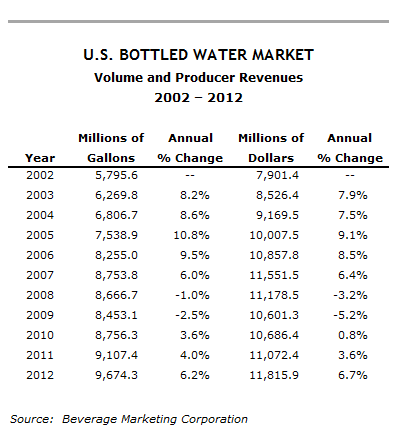
For the visual effect:
The International Bottled Water Association (IBWA) cited a bright future for bottled water sales last spring, noting a 6.2% increase in bottled water consumption between 2012 and 2013. According to IBWA, U.S. consumption rates work out to an average of 30.8 gallons of water per person per year!
But there's good news for conservationists too. San Francisco just banned the sale of bottled water on public property. How cool is that!? As part of the ordinance, the city will also take steps to provide more "water filling stations" around town. At least in San Francisco, public water won't go the way of the public phone.
While San Francisco marks the first major city to ban bottled water, smaller movements have led the charge. Concord, Massachusetts became the first city to implement a ban when it did so on January 2013. That same month, the University of Vermont became one of the first public universities to implement a ban on bottled water sales. The movement continues to grow with other smaller communities and private universities getting on board. In the latest news, Western Washington University will remove bottled water from campus shelves in just a few days, on April 1st.
If you want to learn more about the movement to ban bottled water, check out the blog Ban the Bottle.
As for me, I'm regrouping. Over the past week, I discovered that really giving up bottled water is not a passive thing. I had no idea the "rare occasions" when I drank bottled water were so frequent. All of my nice friends and acquaintances caught me off guard with their kindness and generosity.
But now I'm ready for them: "Thanks so much, but I've given it up." It's as simple as "Just Say No!" If anyone asks why, I get a chance to spread the word.
So many world problems feel impossible and expensive to solve. This one is so easy.
In the U.S., public water is safe and free.
All we have to do is drink it!
I traded the caffeine (and the stress) for more sleep when I graduated over a decade ago. But my habit of drinking seltzer water continued for several more years. Then one day I looked at my recycle bin and noticed the way it overflowed with empty plastic. Why hadn't that bothered me before? Deciding that was way too much plastic for any one person to produce in a week, so I resolved to quit the habit.
I still drink seltzer, but instead of buying twelve plastic bottles each week, I buy one or two glass bottles instead.
Just a week ago, if you'd asked me if I drank water out of plastic bottles, I'd have said "no way!" I wonder if my feelings of self-righteousness would have showed through. With the exception of "rare occasions" when a plastic bottle of water seemed unavoidable, I did not see myself as part of our growing bottled water problem.
Then last weekend, we watched the documentary Tapped. Have you seen it? It skewers the bottled water industry at every step of the product cycle: from extraction, where beverage companies haul water away from local communities who don't share in the profits; to packaging, where manufacture of the bottles relies on petroleum and harmful chemical elements (BPA when the film was made, antimony now); to testing, which is overseen by one FDA employee; to advertising, which misleads consumers into thinking the water is safer than tap water; to disposal which is turning our oceans into a "plastic soup."
After watching it, you'll vow to never touch another bottle of water again. That's what Steve and I said anyway. Of course, I was thinking in my I'm-already-all-over-this way about how I gave up bottled water years ago, but I didn't say that out loud.
The next day, I went to the coffee shop to work on my book. I don't do this every day - maybe once every one or two weeks. After a long morning drinking decaf and writing, I decided I needed something to eat.
And I was thirsty.
I looked at my drink options: plastic bottles of water, plastic bottles of soda, and glass bottles of juice.
I hesitated. I couldn't drink a bottle of water the day after watching Tapped! But I hate juice, refuse to drink soda (it's in plastic anyway) and couldn't stand the idea of another sweet drink after all the coffee I'd had (I'm not a black coffee kind of girl).
What should I do? I could hear the people behind me shuffling their feet in line. Their looks of "make up your mind!" drilled into the back of my head as I tottered on the edge of a panic-purchase.
My mind raced. I didn't have a reusable water bottle with me, and besides, would it be fair to bring my own drink after sitting in this restaurant using their electricity and wifi all day? I felt like I owed the proprietors my business.
So I did it. I pulled a crinkly bottle of water out of the ice, purchased it, and drank it. The day after watching Tapped.
Just this once.
Two nights later, I co-hosted a team-dinner for my son's soccer team. The other family provided drinks: two cases of water and a case of Gatorade. Egad! That was more water bottles than I wanted to be responsible for in a year!
An hour or two into the evening, I offhandedly mentioned how thirsty I was to Steve. The other mom heard me and kindly brought me a bottle of water. "Oh, thanks!" I said with a pained smile. I didn't know what to do. Could I sneak through the living room, return the bottle to the cooler, then rummage through her cupboards for a glass without her noticing? And would it matter if I did? Someone was going to drink that bottle of water, whether I did or not.
My friend stood in front of me, expecting me to guzzle down this drink with relief. Not wanting to be rude, I twisted off the plastic top with a crackle, and drank up.
Later, I noticed Steve doing it too.
Just this once.
Three days later, I volunteered to help out at my daughter's swim meet. I brought a reusable water bottle with me because all-day meets in hot indoor pools never fail to dehydrate me. In the afternoon, I sat at the scoring table entering meet results into a computer. Toward the end of the meet, things became frenzied as we worked to finish the events on time. I had drained my water bottle long before. Parched, I asked a swimmer if they could refill my bottle at a water fountain. Before I could stop her, another mom intercepted, explaining there was no need to do that because "We have a whole cooler of water bottles right here!" She was nice enough to bring me one.
And I drank it.
Just this once.
"Just this once" turned out to be three bottles of water within one week of watching Tapped! That's hardly a record of abstinence.
If I were in high school trying not to get pregnant, I'd be in big trouble.
I still feel completely committed to the idea that I should never drink or purchase a bottle of water again. What I discovered, however, is how much our culture has acclimated to this idea of portable water. With bottles so omnipresent, other ways of accessing and drinking water (like large thermoses, pitchers and, imagine: CUPS!) have disappeared.
I'm sure I'm not the only person who watched Tapped and swore myself off of bottled water. And I bet I'm also not the only person to discover this can be a challenge.
As a country, we consume bottled water like it's...well...water. Check out the numbers. Between 2009 (when Tapped came out) and 2012, sale of bottled water increased by 1.2 BILLION gallons!
For the visual effect:
 |
| Data from the Beverage Marketing Corporation. Graph by Peter Gleick |

The International Bottled Water Association (IBWA) cited a bright future for bottled water sales last spring, noting a 6.2% increase in bottled water consumption between 2012 and 2013. According to IBWA, U.S. consumption rates work out to an average of 30.8 gallons of water per person per year!
But there's good news for conservationists too. San Francisco just banned the sale of bottled water on public property. How cool is that!? As part of the ordinance, the city will also take steps to provide more "water filling stations" around town. At least in San Francisco, public water won't go the way of the public phone.
While San Francisco marks the first major city to ban bottled water, smaller movements have led the charge. Concord, Massachusetts became the first city to implement a ban when it did so on January 2013. That same month, the University of Vermont became one of the first public universities to implement a ban on bottled water sales. The movement continues to grow with other smaller communities and private universities getting on board. In the latest news, Western Washington University will remove bottled water from campus shelves in just a few days, on April 1st.
If you want to learn more about the movement to ban bottled water, check out the blog Ban the Bottle.
As for me, I'm regrouping. Over the past week, I discovered that really giving up bottled water is not a passive thing. I had no idea the "rare occasions" when I drank bottled water were so frequent. All of my nice friends and acquaintances caught me off guard with their kindness and generosity.
But now I'm ready for them: "Thanks so much, but I've given it up." It's as simple as "Just Say No!" If anyone asks why, I get a chance to spread the word.
So many world problems feel impossible and expensive to solve. This one is so easy.
In the U.S., public water is safe and free.
All we have to do is drink it!
Sunday, March 16, 2014
strawberry smoothie mandate
Last year, I wrote in lazy locavore hangover about how I couldn't get inspired to cook or do the work of food preservation for the coming winter. Cooking usually feels like a creative outlet for me, and preparing/preserving/eating local organic food feels like a spiritual practice. But last spring and summer, something was missing in all of that. For the first time in as long as I could remember, food felt like a chore.
As the winter winds down and I remember that lethargy, I am surprised to realize that somehow, I still pulled it off. We ate well this winter. In jars we had the usual suspects: apple and tomato sauces, peaches, pears and green beans among other things. We also had some new foods like pickled beets (they were delicious!), pickled peppers (yum!), and BBQ sauce (Yuck. It needed some serious doctoring out of the jar).
In the freezer we had various roasts, a few racks of ribs, a little ground meat, a lot of breakfast sausage, half of a lamb, and over 20 whole chickens.
I don't know why, but for me, there is something obscene about all those birds. When I layered them on the shelves with packages of wings, legs and thighs last fall, I couldn't help but wonder if the birds minded sharing space with so many packages of parts. I had this gruesome flash of how I'd feel packed into a room surrounded by bags full of frozen elbows. Ugh. My throat felt a little tight at the thought.
With an imagination like that, I suppose I am well-suited for vegetarianism (or lessatarianism to be more accurate).
When March arrived a few weeks ago, I looked in the freezer feeling satisfied. While I still had plenty of food for the next few months, I also saw a lot of empty space. Many of the birds had flown the coop (if we want to fool ourselves in that way). The green beans, collard balls, corn, black-eyed peas, and various kinds of pesto had dwindled. I was just thinking how well I'd planned when I looked at the top shelf, the one reserved for fruit and saw it was...FULL.
Holy Toledo!--we forgot to eat the fruit!
That top shelf sat bulging with 4 gallons of strawberries, 2 gallons of blueberries, 1 gallon of pears, a few random small bags of melon, and several quarts of raspberries. Aside from uses like muffins and pancakes, this stash was supposed to fuel a winter's worth of smoothies.
What happened?
I could say it was my hoarder instinct in overdrive. And I'm sure there'd be some truth in that. Sometimes I get so caught up in the gathering and storing "for later" I forget that "later" is NOW. This is especially true of the strawberries because I freeze them in May and must look at them for months before I'm "allowed" to break into them.
But that's not the whole truth.
If this local and mostly organic fruit didn't fuel my winter smoothies as intended, then what did?
Oh, I don't know. Maybe a banana or two?
Some almonds?
A bit of chocolate?
I might have added a "splash" of coconut milk.
And sugar.
It's true.
There is NOTHING local about a chocolate-banana-almond-coconut shake!
Unless, of course, you live within 20 degrees latitude of the EQUATOR.
Egad.
All I can say is: I got addicted. Surely that is some kind of defense? I think it was the caffeine in the chocolate. I don't otherwise drink caffeine, and I found myself waking up every morning saying, "Don't talk to me. I can't think before I've had my chocolate-banana-almond-coconut shake!"
In my chocolate delirium, I plum forgot about the fruit.
Now, spring is a week away (one week! woohoo!). Except holy crap - we've got a lot of frozen fruit to eat. There's only one thing worse than running out of your winter stores before the new growing season starts, and that's leaving your winter stores uneaten.
It feels so wasteful--of the food left over and the time spent preparing it.
So we've been hitting the strawberries hard. We've been under a near daily strawberry smoothie mandate for two weeks and have already polished off two gallons of them.
My kids have no idea why there's suddenly an influx of berry flavored stuff on the menu. I wonder what exactly goes through their heads as they endure my manic directives.
In one day I can swing from "Don't touch those strawberries!" to "Good God! Why haven't you eaten more strawberries!"
We have an urgency around food that wouldn't exist if we shopped for this stuff at the grocery store.
Or if, perhaps, the person in charge of all this food storage and consumption was a tad less neurotic.
Or forgetful.
Or susceptible to the intoxications of chocolate and coconut in a blender.
Still, despite the berry mania, I feel like we're in good shape as we ride out this last week of winter. In reality, I discovered the fruit just in time. After all, it's not like it'll start raining berries on March 23rd. We still have two months before fresh fruit will appear in the markets.
And I'm happy to say that, unlike my lethargy of last year, I feel tired of this year's winter food coma. After such a frigid season, I'm more than ready to do the work of eating fresh food and am happy to make my chocolate shake addiction a distant memory--an anomaly of a winter gone by.
As the winter winds down and I remember that lethargy, I am surprised to realize that somehow, I still pulled it off. We ate well this winter. In jars we had the usual suspects: apple and tomato sauces, peaches, pears and green beans among other things. We also had some new foods like pickled beets (they were delicious!), pickled peppers (yum!), and BBQ sauce (Yuck. It needed some serious doctoring out of the jar).
In the freezer we had various roasts, a few racks of ribs, a little ground meat, a lot of breakfast sausage, half of a lamb, and over 20 whole chickens.
I don't know why, but for me, there is something obscene about all those birds. When I layered them on the shelves with packages of wings, legs and thighs last fall, I couldn't help but wonder if the birds minded sharing space with so many packages of parts. I had this gruesome flash of how I'd feel packed into a room surrounded by bags full of frozen elbows. Ugh. My throat felt a little tight at the thought.
With an imagination like that, I suppose I am well-suited for vegetarianism (or lessatarianism to be more accurate).
When March arrived a few weeks ago, I looked in the freezer feeling satisfied. While I still had plenty of food for the next few months, I also saw a lot of empty space. Many of the birds had flown the coop (if we want to fool ourselves in that way). The green beans, collard balls, corn, black-eyed peas, and various kinds of pesto had dwindled. I was just thinking how well I'd planned when I looked at the top shelf, the one reserved for fruit and saw it was...FULL.
Holy Toledo!--we forgot to eat the fruit!
That top shelf sat bulging with 4 gallons of strawberries, 2 gallons of blueberries, 1 gallon of pears, a few random small bags of melon, and several quarts of raspberries. Aside from uses like muffins and pancakes, this stash was supposed to fuel a winter's worth of smoothies.
What happened?
I could say it was my hoarder instinct in overdrive. And I'm sure there'd be some truth in that. Sometimes I get so caught up in the gathering and storing "for later" I forget that "later" is NOW. This is especially true of the strawberries because I freeze them in May and must look at them for months before I'm "allowed" to break into them.
But that's not the whole truth.
If this local and mostly organic fruit didn't fuel my winter smoothies as intended, then what did?
Oh, I don't know. Maybe a banana or two?
Some almonds?
A bit of chocolate?
I might have added a "splash" of coconut milk.
And sugar.
It's true.
There is NOTHING local about a chocolate-banana-almond-coconut shake!
Unless, of course, you live within 20 degrees latitude of the EQUATOR.
Egad.
All I can say is: I got addicted. Surely that is some kind of defense? I think it was the caffeine in the chocolate. I don't otherwise drink caffeine, and I found myself waking up every morning saying, "Don't talk to me. I can't think before I've had my chocolate-banana-almond-coconut shake!"
In my chocolate delirium, I plum forgot about the fruit.
Now, spring is a week away (one week! woohoo!). Except holy crap - we've got a lot of frozen fruit to eat. There's only one thing worse than running out of your winter stores before the new growing season starts, and that's leaving your winter stores uneaten.
It feels so wasteful--of the food left over and the time spent preparing it.
So we've been hitting the strawberries hard. We've been under a near daily strawberry smoothie mandate for two weeks and have already polished off two gallons of them.
My kids have no idea why there's suddenly an influx of berry flavored stuff on the menu. I wonder what exactly goes through their heads as they endure my manic directives.
In one day I can swing from "Don't touch those strawberries!" to "Good God! Why haven't you eaten more strawberries!"
We have an urgency around food that wouldn't exist if we shopped for this stuff at the grocery store.
Or if, perhaps, the person in charge of all this food storage and consumption was a tad less neurotic.
Or forgetful.
Or susceptible to the intoxications of chocolate and coconut in a blender.
Still, despite the berry mania, I feel like we're in good shape as we ride out this last week of winter. In reality, I discovered the fruit just in time. After all, it's not like it'll start raining berries on March 23rd. We still have two months before fresh fruit will appear in the markets.
And I'm happy to say that, unlike my lethargy of last year, I feel tired of this year's winter food coma. After such a frigid season, I'm more than ready to do the work of eating fresh food and am happy to make my chocolate shake addiction a distant memory--an anomaly of a winter gone by.
Thursday, February 27, 2014
anchor of death: or teens, blogging & transition
I've written before about the difficulties of raising teens. One day your kids think you walk on water, the next they think you're the anchor of death, threatening with your mere presence to drag them to the sea-floor of all that is uncool and embarrassing.
I started this blog right on the cusp of this teen adventure, when Gareth (now almost 17) and Olivia (now 13) were 14 and 10 respectively. Although Gareth was already a teenager, he'd slipped into that rather quietly, and it hadn't yet sunk in for me. I still imagined my kids were kids: attached to me, influenced by me, mine.
The transition to "anchor of death" has taken some doing (in my mind, not theirs). And one place where I've felt awkward about my new role has been on this blog.
When I started writing here, the name "small house, big picture" referred to how the activities of one household connect to the world outside of it. An easy example of this would be how our consumption and disposal habits contribute to the pile at the dump. But I also thought of this connection in terms of parenthood: our household would teach by example that each of us is more than an important individual; we are all members of a string of communities: from family, to school, to town, to nation, to planet. I wanted to raise children who were not just loving and caring individuals, but active citizens of the nation and responsible stewards of the planet.
It all sounds so lofty now. And it was great for a while. It was easy to feed my toddlers local organic snacks and say we were a green household. But when the toddlers grow up, they eat industrial snacks like Ramen noodles and drink sugary food-dye laden beverages like Gatorade out of, it's true: plastic bottles. If that's not enough for my faint green mother's heart, they throw those bottles in their bedroom trash cans instead of the recycle bin! Egad. When you ask why they didn't adhere to this most basic of green household activities, they'll say, "Oh, sorry. I forgot--" as if you haven't been teaching this practice since they were old enough to walk. They'll promise to rectify the matter later, but they won't.
A good parent knows to stand back during this time, to trust in what you've taught and let your teen experiment with his or her autonomy. Teens need to make mistakes and try things their own way so they can decide for themselves if they agree with their parents' way of thinking, right? I know I need to pick my battles and keep my mouth shut. But it's so hard!
To be fair, my kids are great. As far as I know, nobody's on drugs, or bullying their classmates, or shoplifting cigarettes from the corner market. They're just typical teens in an our-mother-is-a-hippie-freak kind of way: they're lazy about recycling, never turn off the lights, and take showers that far exceed the recommended 5 minutes touted by many water conservationists. (Although I have to give them a break because I do this too!) And they roll their eyes at me a lot.
The point of all this is that I began to feel uncomfortable about how to write about "our" environmentally conscientious household. Are we really all small-house-big-picture around here if my kids think I'm a kook? I hadn't forgotten the rule about how teens will reject everything I've taught them until they hit their twenties. It's just that I discovered how hard it is to wait that long to see the fruits of my labor.
So this is yet another reason why I haven't been writing as much.
With time, however, I'm getting used to being the anchor of death. It's not so bad, really. I've also figured out this is still small-house around here, even if I'm the only one who turns off all the lights, loves the compost heap like it's an old friend, or is willing to try brushing my teeth with a piece of bark (I haven't actually tried it yet - will let you know how that goes if I do!). Part of this transition into parenting teens is remembering that you live your life the way you do because it's what you want, not just because you hope your kids will want it too.
That's what I should be writing about.
Just as I'm figuring this out and feeling good about it, Olivia comes home from school and says, "Hey mom, it turns out my English teacher is a 'crazy hippie' like you!" Then she shows me this "totally cool" video she's been "waiting all day" to share with me because she knows how much I'll LOVE it.
So I watch it, not sure what to expect, and it's a Chipotle ad. Perhaps you've seen it:
I do love it. And what a bonus to discover she's been listening all along.
I started this blog right on the cusp of this teen adventure, when Gareth (now almost 17) and Olivia (now 13) were 14 and 10 respectively. Although Gareth was already a teenager, he'd slipped into that rather quietly, and it hadn't yet sunk in for me. I still imagined my kids were kids: attached to me, influenced by me, mine.
The transition to "anchor of death" has taken some doing (in my mind, not theirs). And one place where I've felt awkward about my new role has been on this blog.
When I started writing here, the name "small house, big picture" referred to how the activities of one household connect to the world outside of it. An easy example of this would be how our consumption and disposal habits contribute to the pile at the dump. But I also thought of this connection in terms of parenthood: our household would teach by example that each of us is more than an important individual; we are all members of a string of communities: from family, to school, to town, to nation, to planet. I wanted to raise children who were not just loving and caring individuals, but active citizens of the nation and responsible stewards of the planet.
It all sounds so lofty now. And it was great for a while. It was easy to feed my toddlers local organic snacks and say we were a green household. But when the toddlers grow up, they eat industrial snacks like Ramen noodles and drink sugary food-dye laden beverages like Gatorade out of, it's true: plastic bottles. If that's not enough for my faint green mother's heart, they throw those bottles in their bedroom trash cans instead of the recycle bin! Egad. When you ask why they didn't adhere to this most basic of green household activities, they'll say, "Oh, sorry. I forgot--" as if you haven't been teaching this practice since they were old enough to walk. They'll promise to rectify the matter later, but they won't.
A good parent knows to stand back during this time, to trust in what you've taught and let your teen experiment with his or her autonomy. Teens need to make mistakes and try things their own way so they can decide for themselves if they agree with their parents' way of thinking, right? I know I need to pick my battles and keep my mouth shut. But it's so hard!
To be fair, my kids are great. As far as I know, nobody's on drugs, or bullying their classmates, or shoplifting cigarettes from the corner market. They're just typical teens in an our-mother-is-a-hippie-freak kind of way: they're lazy about recycling, never turn off the lights, and take showers that far exceed the recommended 5 minutes touted by many water conservationists. (Although I have to give them a break because I do this too!) And they roll their eyes at me a lot.
The point of all this is that I began to feel uncomfortable about how to write about "our" environmentally conscientious household. Are we really all small-house-big-picture around here if my kids think I'm a kook? I hadn't forgotten the rule about how teens will reject everything I've taught them until they hit their twenties. It's just that I discovered how hard it is to wait that long to see the fruits of my labor.
So this is yet another reason why I haven't been writing as much.
With time, however, I'm getting used to being the anchor of death. It's not so bad, really. I've also figured out this is still small-house around here, even if I'm the only one who turns off all the lights, loves the compost heap like it's an old friend, or is willing to try brushing my teeth with a piece of bark (I haven't actually tried it yet - will let you know how that goes if I do!). Part of this transition into parenting teens is remembering that you live your life the way you do because it's what you want, not just because you hope your kids will want it too.
That's what I should be writing about.
Just as I'm figuring this out and feeling good about it, Olivia comes home from school and says, "Hey mom, it turns out my English teacher is a 'crazy hippie' like you!" Then she shows me this "totally cool" video she's been "waiting all day" to share with me because she knows how much I'll LOVE it.
So I watch it, not sure what to expect, and it's a Chipotle ad. Perhaps you've seen it:
I do love it. And what a bonus to discover she's been listening all along.
Wednesday, January 15, 2014
bits and pieces
Well. I generally feel like it's bad form to write blog posts about how you haven't been posting, so naturally, I'm going to do it.
You may have noticed things grinding to a crawl around here. I admit my time for blogging has dwindled. It's not for lack of interest, rather, for something much better: greed. Or perhaps I should just say: money. This fall, I decided to pursue editing and writing projects that pay. Of course, when you try to make your hobby into your living, the hobby inevitably suffers. That doesn't mean I don't plan to write here anymore--I do!--it just means I've had less time.
And that will change.
It will change because the real drain on my time has been my book. What book, you say? Ahh, yes. That is the problem:
What book.
I started a memoir almost 8 years ago when I quit my adjunct professor work. The book traces my professional life from corporate ladder climber, to grad student, to my work as an adjunct English professor. It culminates with my decision to leave academia (woops. I guess I should have given you a spoiler alert!). I've worked on this project for years in, you guessed it, bits and pieces, only carving out time when I wasn't child-rearing, grant writing, tutoring and/or cooking. You can see why it's taken so long. I hope.
But now, the time to publish is ripe. The working conditions and employment prospects in academe have sunk to new lows and more people are speaking out. While I'm participating in that conversation through twitter and on my other blog, Professor Never, publishing my memoir and telling my story would give me closure on that part of my life. I have a real sense of urgency about finishing.
So I've been working on it A LOT. I can be a "bit" monomaniacal about writing projects. I have trouble drawing boundaries around the work, forgetting to drink water, cook dinner, or to go to bed.
The same thing happened with my dissertation.
The consequence? Everything around me crumbles into bits and pieces.
This blog, with a post here and a post there, looks as neglected as the parsnips that have languished in bits and pieces in my vegetable drawer since the last co-op delivery in November!
And what's up with those parsnips anyway?! And the turnips. And the butternut squash--these remnants of fresh stuff I've neglected nag at my conscience. Don't worry, we haven't resorted to McDonald's every night (or ever), but my meal planning is more haphazard, and my plans less ambitious. I've been falling back on the greens I pre-cut and froze in October, or the almost-ready-to-eat beans I canned in September. I "forget" about the squash and turnips that need to be washed and chopped--egad.
At the same time, stores of other winter foods have dwindled to their own meager collection of bits and pieces: white potatoes, garlic and apples are in short supply from our co-op. I could supplement with trips to the winter market, but I've reduced even those trips to bits and pieces as well, with late Friday nights and cold Saturday mornings collaborating to keep me home.
My herbs, which are way ready for the jar, still hang from my pan rack and other sundry places about the kitchen, begging me to bottle them up by dropping bits of themselves onto my counters in despair. I sweep them up and wonder, should the pieces go into the compost, or our dinner? Who will know?
Even my primary paying job: tutoring, has grown sporadic. I've cut back on my students to make time for freelance writing/editing jobs that I can do while the kids are at school. But in the transition to finding new work, I have felt the spaces open up between appointments. Whether that's good or bad, shouldn't it at least mean I have more time to do the things I always used to manage anyway? You'd think. But exercise, meditation, email maintenance (what a drag that's a thing now), laundry and Christmas thank-you notes (I've written only one) occur in smatterings. What good is just a "bit" of exercise or one clean "piece" of laundry?
It all gets sacrificed to the book.
Still, I have managed to step away from the memoir to write a few other related "pieces." I published an article in Inside Higher Ed a few weeks ago. You can see that here if you want to read my post-academic rantings about the perils of seeking a humanities Ph.D. I also submitted an excerpt from the memoir to a literary magazine back in October. That rejection should arrive in my inbox any day, so I hate to even mention it. But no worries. I will not crumble into bits and pieces when I get the news. Like most writers, I'm an old hand at taking rejection.
In the coming weeks, I will continue to make my book revisions a priority, but I will also try not to be such a stranger around here. I miss this blog, the ideas it generated for me, and the small community that grew up around it (that's you if you're still out there!). You know I have bits and pieces of a zillion different posts floating around in my head. Writing here more regularly would clear my mind and hopefully help me to see the minutia of life that lies littered around me not as evidence of my neglect, but of my industry!
You may have noticed things grinding to a crawl around here. I admit my time for blogging has dwindled. It's not for lack of interest, rather, for something much better: greed. Or perhaps I should just say: money. This fall, I decided to pursue editing and writing projects that pay. Of course, when you try to make your hobby into your living, the hobby inevitably suffers. That doesn't mean I don't plan to write here anymore--I do!--it just means I've had less time.
And that will change.
It will change because the real drain on my time has been my book. What book, you say? Ahh, yes. That is the problem:
What book.
I started a memoir almost 8 years ago when I quit my adjunct professor work. The book traces my professional life from corporate ladder climber, to grad student, to my work as an adjunct English professor. It culminates with my decision to leave academia (woops. I guess I should have given you a spoiler alert!). I've worked on this project for years in, you guessed it, bits and pieces, only carving out time when I wasn't child-rearing, grant writing, tutoring and/or cooking. You can see why it's taken so long. I hope.
But now, the time to publish is ripe. The working conditions and employment prospects in academe have sunk to new lows and more people are speaking out. While I'm participating in that conversation through twitter and on my other blog, Professor Never, publishing my memoir and telling my story would give me closure on that part of my life. I have a real sense of urgency about finishing.
So I've been working on it A LOT. I can be a "bit" monomaniacal about writing projects. I have trouble drawing boundaries around the work, forgetting to drink water, cook dinner, or to go to bed.
The same thing happened with my dissertation.
The consequence? Everything around me crumbles into bits and pieces.
This blog, with a post here and a post there, looks as neglected as the parsnips that have languished in bits and pieces in my vegetable drawer since the last co-op delivery in November!
And what's up with those parsnips anyway?! And the turnips. And the butternut squash--these remnants of fresh stuff I've neglected nag at my conscience. Don't worry, we haven't resorted to McDonald's every night (or ever), but my meal planning is more haphazard, and my plans less ambitious. I've been falling back on the greens I pre-cut and froze in October, or the almost-ready-to-eat beans I canned in September. I "forget" about the squash and turnips that need to be washed and chopped--egad.
At the same time, stores of other winter foods have dwindled to their own meager collection of bits and pieces: white potatoes, garlic and apples are in short supply from our co-op. I could supplement with trips to the winter market, but I've reduced even those trips to bits and pieces as well, with late Friday nights and cold Saturday mornings collaborating to keep me home.
My herbs, which are way ready for the jar, still hang from my pan rack and other sundry places about the kitchen, begging me to bottle them up by dropping bits of themselves onto my counters in despair. I sweep them up and wonder, should the pieces go into the compost, or our dinner? Who will know?
Even my primary paying job: tutoring, has grown sporadic. I've cut back on my students to make time for freelance writing/editing jobs that I can do while the kids are at school. But in the transition to finding new work, I have felt the spaces open up between appointments. Whether that's good or bad, shouldn't it at least mean I have more time to do the things I always used to manage anyway? You'd think. But exercise, meditation, email maintenance (what a drag that's a thing now), laundry and Christmas thank-you notes (I've written only one) occur in smatterings. What good is just a "bit" of exercise or one clean "piece" of laundry?
It all gets sacrificed to the book.
Still, I have managed to step away from the memoir to write a few other related "pieces." I published an article in Inside Higher Ed a few weeks ago. You can see that here if you want to read my post-academic rantings about the perils of seeking a humanities Ph.D. I also submitted an excerpt from the memoir to a literary magazine back in October. That rejection should arrive in my inbox any day, so I hate to even mention it. But no worries. I will not crumble into bits and pieces when I get the news. Like most writers, I'm an old hand at taking rejection.
In the coming weeks, I will continue to make my book revisions a priority, but I will also try not to be such a stranger around here. I miss this blog, the ideas it generated for me, and the small community that grew up around it (that's you if you're still out there!). You know I have bits and pieces of a zillion different posts floating around in my head. Writing here more regularly would clear my mind and hopefully help me to see the minutia of life that lies littered around me not as evidence of my neglect, but of my industry!
Wednesday, November 13, 2013
dinner: it takes a family
Does one person take responsibility for getting dinner on the table in your house? I love to cook, so that's how it used to be around here. That changed when I started tutoring in the afternoons/evenings almost a decade ago. I never sat down to map out a new plan, but one evolved.
Monday is my busiest day: I grocery shop and write/edit in the morning, tutor at my house from 12pm to 5pm, then leave for the evening at 5:30, dropping Olivia at her three hour swim practice on my way to a writer's meeting that usually ends around 9:15.
Here is how this past Monday night's dinner found its way to our table:
On Sunday night, I marinated a flank steak and stuck in the fridge for overnight. When I finished tutoring at 5pm the next day, I chopped up some bok choy and garlic and left them in a bowl next to the stove. Then, just before leaving with Olivia at 5:30, I put millet on the stove to cook and left Gareth to watch over it. Gareth did his homework on the bar in our kitchen so he could keep an eye on the pot. When the Millet finished cooking, he took it off the heat and carried on with his homework.
Steve arrived home thirty minutes later, grilled the marinated flank steak, put it in the fridge, then left with Gareth to coach Gareth's soccer practice. When we all arrived home at 9:30pm (egad!), Olivia set the table, Gareth poured drinks, Steve cut the meat, I sauteed the bok choy and garlic, someone served the millet and voila!– dinner was served.
Craziness!
If you're thinking we're insane to dine so late, you're right, but we do it on some nights because it's the only time we can eat together. And if my Monday night sounds like a logistical nightmare, I should tell you I didn't plan it.
It just happened.
I do try to plan simpler dinners on crazier nights, but as to how it gets prepared? I wing it. It's just a matter of doling out responsibilities according to skills and availability. And all kids have skills. They can wash, peel and chop vegetables, cook rice or pasta, stir soups, baste meats, start the grill, and wash dishes.
You'd be surprised, even the littlest fingers can peel garlic, which happens to be the most annoying job in the kitchen! Olivia has peeled piles of it for me over the years, usually while sitting in front of her latest show. I send her off with a whole head and she comes back with this beautiful pile of shiny cloves. Just don't ask me where all those papery skins end up.
Through this process of sharing responsibility, we discovered that dinner is not one job, but many. And the cook? Not one person, but one family.
Tag-teaming dinner has more than practical benefits. Cooking teaches kids that we all need to take responsibility for the food we eat (mom is not the de facto cook in the house unless she chooses to be). It also teaches hands-on that high quality healthy food doesn't come out of a plastic bag or a box--it comes from raw materials. And of course, cooking teaches cooking! If our kids go out into the world knowing how to cook, they'll be more likely to eat healthy meals made from whole foods when they are adults.
That all sounds great, but I don't want to mislead you into thinking I have miracle children. While Steve and I almost always tag-team dinner, the kids don't help every night, and I'm sure you can imagine the freak-out that occurs on the nights when I do ask. The outrage, the indignity, the affront!
Still, of all the chores we might coerce our kids into doing, this one offers the best kid-friendly payoff. They don't care about the urine on the base of the toilet seat or the dust on the television. But they do care about food. You want cookies? Melt some butter. You want homemade ranch dressing? Get out the mayo and go cut some chives.
Of course, like anything, cooking has a learning curve. Years ago I left Gareth to cook a chicken while I went to tutor. I'd cleaned and prepped it, so "all he had to do" was put the bird in the oven at 5pm then set a timer to baste it every 20 minutes. He didn't have to worry about when it would be done because his dad would be home in time to take it out of the oven.
Simple, right?
When Steve arrived home at 6pm and checked on the bird, he discovered an ice-cold chicken shivering in an ice-cold oven, it's little wings tucked in tight against the frigid air. Gareth had dutifully basted a raw chicken every twenty minutes for an hour without ever turning on the heat! When I asked him if he noticed the chicken hadn't cooked he said, "I thought it just took a long time."
I suppose the moral of that story is it doesn't have to be perfect (although I prefer dinner not be raw). If you're having trouble finding time to get dinner on the table, it's okay to consider the crew of worker bees that is your family. I know the kids are busy too, so if they have a freak-out, just remind them they don't have to make the whole meal (the point is that nobody does). But if they want a decent homemade dinner in these hectic times, it takes a family.
Monday is my busiest day: I grocery shop and write/edit in the morning, tutor at my house from 12pm to 5pm, then leave for the evening at 5:30, dropping Olivia at her three hour swim practice on my way to a writer's meeting that usually ends around 9:15.
Here is how this past Monday night's dinner found its way to our table:
On Sunday night, I marinated a flank steak and stuck in the fridge for overnight. When I finished tutoring at 5pm the next day, I chopped up some bok choy and garlic and left them in a bowl next to the stove. Then, just before leaving with Olivia at 5:30, I put millet on the stove to cook and left Gareth to watch over it. Gareth did his homework on the bar in our kitchen so he could keep an eye on the pot. When the Millet finished cooking, he took it off the heat and carried on with his homework.
Steve arrived home thirty minutes later, grilled the marinated flank steak, put it in the fridge, then left with Gareth to coach Gareth's soccer practice. When we all arrived home at 9:30pm (egad!), Olivia set the table, Gareth poured drinks, Steve cut the meat, I sauteed the bok choy and garlic, someone served the millet and voila!– dinner was served.
Craziness!
If you're thinking we're insane to dine so late, you're right, but we do it on some nights because it's the only time we can eat together. And if my Monday night sounds like a logistical nightmare, I should tell you I didn't plan it.
It just happened.
I do try to plan simpler dinners on crazier nights, but as to how it gets prepared? I wing it. It's just a matter of doling out responsibilities according to skills and availability. And all kids have skills. They can wash, peel and chop vegetables, cook rice or pasta, stir soups, baste meats, start the grill, and wash dishes.
You'd be surprised, even the littlest fingers can peel garlic, which happens to be the most annoying job in the kitchen! Olivia has peeled piles of it for me over the years, usually while sitting in front of her latest show. I send her off with a whole head and she comes back with this beautiful pile of shiny cloves. Just don't ask me where all those papery skins end up.
Through this process of sharing responsibility, we discovered that dinner is not one job, but many. And the cook? Not one person, but one family.
Tag-teaming dinner has more than practical benefits. Cooking teaches kids that we all need to take responsibility for the food we eat (mom is not the de facto cook in the house unless she chooses to be). It also teaches hands-on that high quality healthy food doesn't come out of a plastic bag or a box--it comes from raw materials. And of course, cooking teaches cooking! If our kids go out into the world knowing how to cook, they'll be more likely to eat healthy meals made from whole foods when they are adults.
That all sounds great, but I don't want to mislead you into thinking I have miracle children. While Steve and I almost always tag-team dinner, the kids don't help every night, and I'm sure you can imagine the freak-out that occurs on the nights when I do ask. The outrage, the indignity, the affront!
Still, of all the chores we might coerce our kids into doing, this one offers the best kid-friendly payoff. They don't care about the urine on the base of the toilet seat or the dust on the television. But they do care about food. You want cookies? Melt some butter. You want homemade ranch dressing? Get out the mayo and go cut some chives.
Of course, like anything, cooking has a learning curve. Years ago I left Gareth to cook a chicken while I went to tutor. I'd cleaned and prepped it, so "all he had to do" was put the bird in the oven at 5pm then set a timer to baste it every 20 minutes. He didn't have to worry about when it would be done because his dad would be home in time to take it out of the oven.
Simple, right?
When Steve arrived home at 6pm and checked on the bird, he discovered an ice-cold chicken shivering in an ice-cold oven, it's little wings tucked in tight against the frigid air. Gareth had dutifully basted a raw chicken every twenty minutes for an hour without ever turning on the heat! When I asked him if he noticed the chicken hadn't cooked he said, "I thought it just took a long time."
I suppose the moral of that story is it doesn't have to be perfect (although I prefer dinner not be raw). If you're having trouble finding time to get dinner on the table, it's okay to consider the crew of worker bees that is your family. I know the kids are busy too, so if they have a freak-out, just remind them they don't have to make the whole meal (the point is that nobody does). But if they want a decent homemade dinner in these hectic times, it takes a family.
Tuesday, October 29, 2013
the pumpkinization of october
Have we gone plum-kin crazy?!
I love the fall. It might be my favorite season (Although I say that about every season when it's at the cusp of it's glory. Just ask me about winter on New Year's Day.).
But for today, I'm restricting my praises to autumn. I am drawn throughout the year to it's deep colors, choosing purple, orange and red for all manner of things from dish towels, to sneakers, to the color of my bike. Then there are the fall vegetables. Forget those fragile sissy spears of scallion and asparagus I raved about in April. In October, I want the thump of a butternut squash and the heft of a box of sweet potatoes to celebrate cooler weather.
When I made my first pan of roasted vegetables in September, Olivia came into the kitchen and said, "It smells like school!" (Meaning, it smells like the time of year when school starts, not, it smells like that horrible building in which I'm held prisoner for 6 hours a day 5 days a week!).
These little things - a side dish for dinner that we haven't had in nine months - help us notice and celebrate the year's transitions.
So what's the gripe?
Retailers, eager to exploit the pleasures of a new season, can really drive the thing into the ground if you let them. And pumpkin is the flave-o-fall extraordinaire. In October, I can drink myself into a stupor on pumpkin ale then wake myself up with a pumpkin latte. For breakfast I can smear pumpkin cream cheese on a pumpkin bagel, or if I'm not in the mood for a bagel, I could whip up a batch of pumpkin pancakes from a boxed mix instead. While I'm in the baking section, I may as well snag some pumpkin bread, or pumpkin muffin, or pumpkin scone mix so I have something to go with my pumpkin soup for lunch. And if I don't want soup, I could lather the bakery with pumpkin butter for a special treat!
I can't help but wonder: is there also pumpkin jerky? pumpkin quiche, or perhaps salted, gingered, or candied pumpkin nuggets? None of this is to mention the pumpkin seeds --do they sell them in pumpkin flavor?
When you shop for these pumpkin products, you will notice piles of real but mostly inedible pumpkins posing in Halloween pyramids about the store. How ironic that when I asked the clerk if the pumpkins were edible he looked at me in surprise, "Oh! I don't know!" he said, as if it had never occurred to him to eat a pumpkin before.
Could it be that we are surrounded by pumpkin simulacra?--representations of pumpkin-flavor so prolific that we have forgotten that the flavor of our October coffee (which tastes more like cinnamon and allspice than pumpkin if you ask me) derived in the first place from a vegetable shockingly called: a "pumpkin?"
After surviving the pumpkin pandemonium at the grocery store this morning, I'm thinking again about lessatarianism. I didn't even eat any of that pumpkin flavored stuff, but I still feel a little ill--as if I did. It must be the power of pumpkin-persuasion. Whatever it is, it's got me screaming "less is more!"
As in less pumpkin-flavor. I have nothing against a bounty of actual pumpkins. Here are my pretties for the season:

Even after the grocery trip, I don't feel remotely ill when I look at this pair of squash. One is a little pie pumpkin from my co-op, the other is a Cinderella pumpkin - as good to eat as it is to look at.
If you're in the mood for a real pumpkin too, stop by your local farmer's market--they have the kind you can eat! It's not that the traditional pumpkin patch pumpkin will poison you or anything, but it might bore you to death with its flavorless, skimpy and stringy self.
Instead, get a beautiful, bulgy, knotty orange or green sensation--a Fairy Tale (or Musquee de Provence if you want to be French about it), a Cinderella (pictured above), a Jarrahadale (blue/green/gray that will shock you with its orange flesh), or a Hubbard (big or little, bulbous, orange).
If you want to have fun with it, pick one out for its pumpkin personality rather than for its perfection. Let it cheer your kitchen or family room for a bit, then, when the day arrives, slice the thing open and roast it. You know I'm not a food blogger, so here are the details if you need step-by-step instructions with pretty pictures.
You can scoop out your cooked pumpkin and use it as is, but I like to throw it in a colander and forget about it for an hour to let excess water drain out (unless I'm using it for soup).
I also puree it because some of us are funny about texture around here and don't like any "strings" of pumpkin to show up in our soup or pancakes, but that step is only necessary if you're family is texturally challenged.
If your pumpkin is big, freeze the puree in 1-cup portions so you can pull it out for various recipes. Add it to bread, pancakes, soup, cake and pie, but for god's sake, don't stir it into your coffee or drop dollops into your beer--pureed or not!
We usually cook a pumpkin or two each fall, making sure to save enough puree for a thanksgiving pie. And that's about enough, because as you know, less is more.
Happy Halloween!
I love the fall. It might be my favorite season (Although I say that about every season when it's at the cusp of it's glory. Just ask me about winter on New Year's Day.).
But for today, I'm restricting my praises to autumn. I am drawn throughout the year to it's deep colors, choosing purple, orange and red for all manner of things from dish towels, to sneakers, to the color of my bike. Then there are the fall vegetables. Forget those fragile sissy spears of scallion and asparagus I raved about in April. In October, I want the thump of a butternut squash and the heft of a box of sweet potatoes to celebrate cooler weather.
When I made my first pan of roasted vegetables in September, Olivia came into the kitchen and said, "It smells like school!" (Meaning, it smells like the time of year when school starts, not, it smells like that horrible building in which I'm held prisoner for 6 hours a day 5 days a week!).
These little things - a side dish for dinner that we haven't had in nine months - help us notice and celebrate the year's transitions.
So what's the gripe?
Retailers, eager to exploit the pleasures of a new season, can really drive the thing into the ground if you let them. And pumpkin is the flave-o-fall extraordinaire. In October, I can drink myself into a stupor on pumpkin ale then wake myself up with a pumpkin latte. For breakfast I can smear pumpkin cream cheese on a pumpkin bagel, or if I'm not in the mood for a bagel, I could whip up a batch of pumpkin pancakes from a boxed mix instead. While I'm in the baking section, I may as well snag some pumpkin bread, or pumpkin muffin, or pumpkin scone mix so I have something to go with my pumpkin soup for lunch. And if I don't want soup, I could lather the bakery with pumpkin butter for a special treat!
I can't help but wonder: is there also pumpkin jerky? pumpkin quiche, or perhaps salted, gingered, or candied pumpkin nuggets? None of this is to mention the pumpkin seeds --do they sell them in pumpkin flavor?
When you shop for these pumpkin products, you will notice piles of real but mostly inedible pumpkins posing in Halloween pyramids about the store. How ironic that when I asked the clerk if the pumpkins were edible he looked at me in surprise, "Oh! I don't know!" he said, as if it had never occurred to him to eat a pumpkin before.
Could it be that we are surrounded by pumpkin simulacra?--representations of pumpkin-flavor so prolific that we have forgotten that the flavor of our October coffee (which tastes more like cinnamon and allspice than pumpkin if you ask me) derived in the first place from a vegetable shockingly called: a "pumpkin?"
After surviving the pumpkin pandemonium at the grocery store this morning, I'm thinking again about lessatarianism. I didn't even eat any of that pumpkin flavored stuff, but I still feel a little ill--as if I did. It must be the power of pumpkin-persuasion. Whatever it is, it's got me screaming "less is more!"
As in less pumpkin-flavor. I have nothing against a bounty of actual pumpkins. Here are my pretties for the season:

notice the not-dead-yet plant in the background!
Even after the grocery trip, I don't feel remotely ill when I look at this pair of squash. One is a little pie pumpkin from my co-op, the other is a Cinderella pumpkin - as good to eat as it is to look at.
If you're in the mood for a real pumpkin too, stop by your local farmer's market--they have the kind you can eat! It's not that the traditional pumpkin patch pumpkin will poison you or anything, but it might bore you to death with its flavorless, skimpy and stringy self.
Instead, get a beautiful, bulgy, knotty orange or green sensation--a Fairy Tale (or Musquee de Provence if you want to be French about it), a Cinderella (pictured above), a Jarrahadale (blue/green/gray that will shock you with its orange flesh), or a Hubbard (big or little, bulbous, orange).
If you want to have fun with it, pick one out for its pumpkin personality rather than for its perfection. Let it cheer your kitchen or family room for a bit, then, when the day arrives, slice the thing open and roast it. You know I'm not a food blogger, so here are the details if you need step-by-step instructions with pretty pictures.
You can scoop out your cooked pumpkin and use it as is, but I like to throw it in a colander and forget about it for an hour to let excess water drain out (unless I'm using it for soup).
I also puree it because some of us are funny about texture around here and don't like any "strings" of pumpkin to show up in our soup or pancakes, but that step is only necessary if you're family is texturally challenged.
If your pumpkin is big, freeze the puree in 1-cup portions so you can pull it out for various recipes. Add it to bread, pancakes, soup, cake and pie, but for god's sake, don't stir it into your coffee or drop dollops into your beer--pureed or not!
We usually cook a pumpkin or two each fall, making sure to save enough puree for a thanksgiving pie. And that's about enough, because as you know, less is more.
Happy Halloween!
Sunday, October 20, 2013
shout-out for family dinner
When the kids were toddlers, sitting at the table together felt like a circus. I remember mushy food thrown on the floor, shared and slobbery silverware clattering on the table, halted conversation that competed with one child who banged their sippy cup on the high chair and another who whined about eating peas. Amid the fussing and the mayhem, it's easy to wonder: What's the point? In fact, while Steve and I always sat down to eat as a family when the kids were young, it was a civilized dinner by ourselves that I really craved. THAT sounded like real quality time!
Back in those baby/toddler years, we ate together because that's how Steve and I were raised. It just felt normal. I didn't know that during those nights spent wiping sticky fingers while trying to eat our black beans and rice, we were instilling a routine into all of us that would pay off down the road.
We all know that dinner time is social---even if some nights devolve into things less civilized. But in our digital age, meal time can provide respite from phones, ipods, and other hand-held electronics. When I was a kid, the rule was, "no books at the table"--I clearly grew up in a different century-- but the idea is the same: we should talk to each other.
I've also discovered that mealtime can teach respect for food. Sitting together gives me a chance to brag about my cooking, which of course, I take full advantage of, but it isn't just self-serving. Talking about cooking can reveal its artfulness while reminding the kids that food preparation takes effort, heart and soul.
I also talk about where the food came from: how's that chicken? you know it came from Polyface Farm; or eat up your arugula - it's fresh from our co-op today; or you know that farmer with the big melons (ha!), he said these beets would be like candy. And my favorite: "how 'bout them tomatoes? You know I grew those!" --Except that latter thing happens so seldom with me being a plant killer and all.
Of course, sometimes dinner offers a chance to disrespect the food. No matter how many delicious meals I've prepared over the years, the one that lives in infamy? eggplant custard. I had high hopes when I set out to make it, but it proved a gray and slightly slimy casserole for which superior flavor could not overcome the shortcomings of color and texture. Alas.
Despite such misguided concoctions, mealtime teaches respect for the cook. The rules around our table are far more lax than the ones I grew up with (sit up straight, napkin on your lap, no elbows on the table). I can't be bothered to police the dinner table so closely, but there is one rule I especially treasure: you NEVER eat before the person who prepared your food has sat down to the table. After all the work of making a meal, this one gesture of respect and thanks goes a long way to acknowledging the effort.
This is especially fun when the kids did the work. We can honor them and also shower them with praise: Wow, look how well the vegetables were chopped; this pasta is a perfect al dente; who peeled that garlic?
If you respect the endeavors of the cook, then you are also more likely to eat the food he or she prepared for you.
Then there's respect for each other: it's boring, but it's true that you learn manners when you eat in a group. I never tell Olivia to chew with her mouth closed because her brother does it for me. Better she learn it from him than on a date with a cute guy who doesn't like the looks of her fish and broccoli in partial breakdown.
If you don't want to get kicked by a sibling, you also learn to pass food around the table after you've served yourself, to use your napkin when there's spaghetti sauce on your face, and wait your turn to tell that hilarious story from the lunch room at school.
While I saw over the years that family dinner could do all these great things: teach community, nutrition, manners, and respect, I didn't understand the value of family dinner as a sustained ritual until this summer when suddenly, Gareth had somewhere else to be every night: at Chipotle, playing soccer at the school, at the pool, spending the night at a friend's. He could easily leave in the morning and not return for days--and all that time wearing the same pair of underwear!
I was at first baffled about how to get him back. If he's welcome at the friend's house, or has already eaten out, then why should he come home? Then it hit me: family dinner! After years of eating together, it made perfect sense to him when I said, "have fun, but you have to be home for dinner." We had taught him, perhaps inadvertently, that food is more than a convenience or a pleasure. It is part of the social fabric of our family.
Looking back, I can see the seeds of that idea in bloom. Before we eat, we usually wait for everyone to be seated, but it's not always easy to get everyone to the table. Have you ever called a child to dinner forty-eleven times and gotten no response? When one of our darlings just cannot tear themselves away from Breaking Bad, or Switched at Birth, or whatever other internet/cable sensation has captivated them, we begin our meal without them.
With the other child sitting gleefully at the table with us, we chew quietly and smirk at each other while we wait for the offending family member to notice the silence in the house: the lack of clattering pans in the kitchen, the absence of a bouncing soccer ball in the dining room (no balls at dinner unless they're collard balls!), the long period of time since anyone yelled, "Dinner!" He or she will inevitably come bolting into the dining room: "You ate without me!"
Yes we did.
It surprised me the first time this happened to see how much it mattered to the kids. I suppose no child (or parent for that matter) wants to be cast out of a family ritual.
Rituals bring families together--something about the obligation to one another, the predictability of repetition, the knowledge that we can count on each other to show up, and for dinner: the responsibility of getting the food on the table together (who's turn to set the table? who's getting drinks? someone get those potatoes out of the oven please).
Good or bad, there are things we can count on about dinner: Olivia will never stop talking, then will complain that we never let her talk. Steve will ask us to comment repeatedly on the part of the meal he prepared, regardless if it only accounts for 10% of what's on the plate; Gareth will put ice cubes in his soup even if I tried to let it cool; I will huff when people use salt.
None of that is to say we haven't had some bad times around the table. Who could forget the animal-shaped napkin rings we couldn't use because the kids nearly tore each others' eyes out fighting over the rocking horse?

And that doesn't rival the night when a cabbage roll inspired the debate: is 'frickin' a cuss word.
To make it work, family dinner doesn't always have to be pleasant (but I can say we've definitely laughed more than we've fought); it doesn't have to be fancy (eat cereal together if you have to), it doesn't have to be every night (we have dinner some nights at 9pm and others not at all because of soccer and swim schedules), it just has to be.
As we transition through these teen years and the kids become more independent, I hope that our determination to eat with the kids while they were young will perhaps inspire our kids to eat with us when we're old.
I know I wouldn't mind the company.
Back in those baby/toddler years, we ate together because that's how Steve and I were raised. It just felt normal. I didn't know that during those nights spent wiping sticky fingers while trying to eat our black beans and rice, we were instilling a routine into all of us that would pay off down the road.
We all know that dinner time is social---even if some nights devolve into things less civilized. But in our digital age, meal time can provide respite from phones, ipods, and other hand-held electronics. When I was a kid, the rule was, "no books at the table"--I clearly grew up in a different century-- but the idea is the same: we should talk to each other.
I've also discovered that mealtime can teach respect for food. Sitting together gives me a chance to brag about my cooking, which of course, I take full advantage of, but it isn't just self-serving. Talking about cooking can reveal its artfulness while reminding the kids that food preparation takes effort, heart and soul.
I also talk about where the food came from: how's that chicken? you know it came from Polyface Farm; or eat up your arugula - it's fresh from our co-op today; or you know that farmer with the big melons (ha!), he said these beets would be like candy. And my favorite: "how 'bout them tomatoes? You know I grew those!" --Except that latter thing happens so seldom with me being a plant killer and all.
Of course, sometimes dinner offers a chance to disrespect the food. No matter how many delicious meals I've prepared over the years, the one that lives in infamy? eggplant custard. I had high hopes when I set out to make it, but it proved a gray and slightly slimy casserole for which superior flavor could not overcome the shortcomings of color and texture. Alas.
Despite such misguided concoctions, mealtime teaches respect for the cook. The rules around our table are far more lax than the ones I grew up with (sit up straight, napkin on your lap, no elbows on the table). I can't be bothered to police the dinner table so closely, but there is one rule I especially treasure: you NEVER eat before the person who prepared your food has sat down to the table. After all the work of making a meal, this one gesture of respect and thanks goes a long way to acknowledging the effort.
This is especially fun when the kids did the work. We can honor them and also shower them with praise: Wow, look how well the vegetables were chopped; this pasta is a perfect al dente; who peeled that garlic?
If you respect the endeavors of the cook, then you are also more likely to eat the food he or she prepared for you.
Then there's respect for each other: it's boring, but it's true that you learn manners when you eat in a group. I never tell Olivia to chew with her mouth closed because her brother does it for me. Better she learn it from him than on a date with a cute guy who doesn't like the looks of her fish and broccoli in partial breakdown.
If you don't want to get kicked by a sibling, you also learn to pass food around the table after you've served yourself, to use your napkin when there's spaghetti sauce on your face, and wait your turn to tell that hilarious story from the lunch room at school.
While I saw over the years that family dinner could do all these great things: teach community, nutrition, manners, and respect, I didn't understand the value of family dinner as a sustained ritual until this summer when suddenly, Gareth had somewhere else to be every night: at Chipotle, playing soccer at the school, at the pool, spending the night at a friend's. He could easily leave in the morning and not return for days--and all that time wearing the same pair of underwear!
I was at first baffled about how to get him back. If he's welcome at the friend's house, or has already eaten out, then why should he come home? Then it hit me: family dinner! After years of eating together, it made perfect sense to him when I said, "have fun, but you have to be home for dinner." We had taught him, perhaps inadvertently, that food is more than a convenience or a pleasure. It is part of the social fabric of our family.
Looking back, I can see the seeds of that idea in bloom. Before we eat, we usually wait for everyone to be seated, but it's not always easy to get everyone to the table. Have you ever called a child to dinner forty-eleven times and gotten no response? When one of our darlings just cannot tear themselves away from Breaking Bad, or Switched at Birth, or whatever other internet/cable sensation has captivated them, we begin our meal without them.
With the other child sitting gleefully at the table with us, we chew quietly and smirk at each other while we wait for the offending family member to notice the silence in the house: the lack of clattering pans in the kitchen, the absence of a bouncing soccer ball in the dining room (no balls at dinner unless they're collard balls!), the long period of time since anyone yelled, "Dinner!" He or she will inevitably come bolting into the dining room: "You ate without me!"
Yes we did.
It surprised me the first time this happened to see how much it mattered to the kids. I suppose no child (or parent for that matter) wants to be cast out of a family ritual.
Rituals bring families together--something about the obligation to one another, the predictability of repetition, the knowledge that we can count on each other to show up, and for dinner: the responsibility of getting the food on the table together (who's turn to set the table? who's getting drinks? someone get those potatoes out of the oven please).
Good or bad, there are things we can count on about dinner: Olivia will never stop talking, then will complain that we never let her talk. Steve will ask us to comment repeatedly on the part of the meal he prepared, regardless if it only accounts for 10% of what's on the plate; Gareth will put ice cubes in his soup even if I tried to let it cool; I will huff when people use salt.
None of that is to say we haven't had some bad times around the table. Who could forget the animal-shaped napkin rings we couldn't use because the kids nearly tore each others' eyes out fighting over the rocking horse?

the unwitting source of so much familial strife!
And that doesn't rival the night when a cabbage roll inspired the debate: is 'frickin' a cuss word.
To make it work, family dinner doesn't always have to be pleasant (but I can say we've definitely laughed more than we've fought); it doesn't have to be fancy (eat cereal together if you have to), it doesn't have to be every night (we have dinner some nights at 9pm and others not at all because of soccer and swim schedules), it just has to be.
As we transition through these teen years and the kids become more independent, I hope that our determination to eat with the kids while they were young will perhaps inspire our kids to eat with us when we're old.
I know I wouldn't mind the company.
Tuesday, September 24, 2013
a plant killer and a primadonna go gardening
My sister, Laurie, and I got a plot in a community garden!
After nine months of waiting for a spot to open, we were so excited to get this news that we did silly stuff like photograph our plot stake:

We grew up with a huge vegetable garden. That means that in our day, we picked a lot of green beans; we ate way too much egg plant, and we spent a good number of afternoons huddled on the front stoop while mom and dad fought over how to put jars in the canner (the potential for food spoilage and broken glass in the same activity always put my overly cautious mother right over the edge).
We had fun with it too. Every year, my father would let one zucchini grow unfettered, "just for grins." If you leave a tomato on the vine, it will get riper and riper, but a zucchini? A zucchini will just get bigger and bigger.
A humongous zucchini might be fun to look at, but it's not so great to actually eat. Still, after all that tending and growing, Dad couldn't let it go to waste. So my mother would stuff it. Then we'd all sit around the table gazing in wonder at this tremendous boat of a vegetable that my father had grown. Should we have taken it to the fair?
It's too late for zucchini this year, but the park service insists that we plant something--within two weeks of signing our contract.
With this new sunny space, and the imperative that we move quickly, we raced to our plot, eager to see the site of our future vegetative triumphs.
We found this:

And for some context:

I suppose we should take the rule about keeping your garden plot functional as more of a suggestion than a hard and fast requirement.
Not to be discouraged, we surveyed the situation and made a plan.

We'd clear it out. We'd get something growing. We'd be a great team!

Thankfully, Laurie knows someone (her husband) who knows someone who has the kind of machinery you need to knock a job like this out in a jiffy.

That's great, but there's a glitch. You see, the overgrowth was never our problem.
If you have been reading this blog for a while, I wonder if perhaps you have guessed the real challenge.
When I met Laurie at the plot the second day, I wondered as I watched her digging, if she knew what the real challenge would be.
The thing is, I've had a vegetable garden before. When Steve and I first got married, I persuaded my apartment manager to allow me and the other residents to plant gardens on an empty plot of land. I grew tomatoes, squash, cucumbers, bell peppers and carrots. I loved that garden, laboring over it all summer. I even carried huge cans of water from the distant spigot every day.
As I expected, it grew green and luscious. I strutted around amid my leaves and vines like Foghorn Leghorn himself. Oh, to be young and prideful; I had not yet discovered the true color of my thumb.
Then one day, it died.
Perhaps it wasn't just one day, but little by little, something in the way of disease or critter struck each and every plant I'd grown--before I'd picked a single thing. If I were Laura Ingalls, my journal would have come to a tragic end that year, the words falling off the page as my bony little fingers recorded my final words.
Oh the tragedy.
"How could it all die?" you ask.
You should know.
I am a plant killer, remember? There's really no other way to explain it. These things happen. This kind of "luck" strikes people like me.
I'm not telling my sister any of this. I don't want to dissuade her from our partnership. You never know, she might cut me out of the whole deal.
Instead, I'm scampering around wondering, what can a plant killer hope to grow, starting in late September?
Oh - I know! Why not something I've already begun to kill! Although I haven't had a big vegetable garden since that first travesty, I do grow herbs in my yard's one sunny spot. I dabble with vegetables in there, but they almost always come to a bad end.
This year, I thought I'd try my hand at some fall crops, planting broccoli, spinach and lettuce. To my surprise, they grew heartily. "Everything looks so good!" I thought.
Unfortunately, the deer thought so too. Little by little, they've stripped the leaves in the dark of night, working their way furtively down the row. I know this isn't the same as killing something with your own hands, but still, a better gardener would have deer semen, or deer blood, or whatever it is people in the know use for a deterrent--perhaps a fence?! Not me. I just sit and watch as my little plants disappear, one bite at a time.
Since the new garden has a fence, Laurie and I decided to transplant my broccoli and spinach. She is excited and doesn't appear to understand the kind of liability I pose. Failure wouldn't occur to her anyway because her thumb glows so green it might have uranium in it. When she walks into my house, my plants perk up in desperation, hoping she might notice their plights and intervene.
While Laurie might not see the risks inherent in gardening with a plant-killer, I know full well how much I need her. I was counting on her to give this garden a fighting chance. I was feeling confident she can lead me into the world where plants live long enough to bear fruit.
Then my hopes were dashed when she showed up for our first day of labor wearing earrings and flip flops!

How can a person garden dressed like that!? For god's sake, she's probably even wearing deodorant.
Our whole lives she has out shined me as the fancy pants in the family. I suppose I should revel in the fact that we've found something to do together for which I'm the one with the better outfit.

Still, if she's going to make this happen for me, she needs to get dirty!
You'll be glad to know that like true partners, we switched jobs. I dug the holes (without posing for pictures thank god!) and she did the planting.

It doesn't look like much, but it's a start. Hopefully together, we have what it takes to make this thing grow!
----------------------------------
Interested in a community garden? Check with your local park service to see if you have plots available for rent near you. Ours is cheap - less than $10/month!
After nine months of waiting for a spot to open, we were so excited to get this news that we did silly stuff like photograph our plot stake:

We grew up with a huge vegetable garden. That means that in our day, we picked a lot of green beans; we ate way too much egg plant, and we spent a good number of afternoons huddled on the front stoop while mom and dad fought over how to put jars in the canner (the potential for food spoilage and broken glass in the same activity always put my overly cautious mother right over the edge).
We had fun with it too. Every year, my father would let one zucchini grow unfettered, "just for grins." If you leave a tomato on the vine, it will get riper and riper, but a zucchini? A zucchini will just get bigger and bigger.
A humongous zucchini might be fun to look at, but it's not so great to actually eat. Still, after all that tending and growing, Dad couldn't let it go to waste. So my mother would stuff it. Then we'd all sit around the table gazing in wonder at this tremendous boat of a vegetable that my father had grown. Should we have taken it to the fair?
It's too late for zucchini this year, but the park service insists that we plant something--within two weeks of signing our contract.
With this new sunny space, and the imperative that we move quickly, we raced to our plot, eager to see the site of our future vegetative triumphs.
We found this:

And for some context:

I suppose we should take the rule about keeping your garden plot functional as more of a suggestion than a hard and fast requirement.
Not to be discouraged, we surveyed the situation and made a plan.

We'd clear it out. We'd get something growing. We'd be a great team!

Thankfully, Laurie knows someone (her husband) who knows someone who has the kind of machinery you need to knock a job like this out in a jiffy.

That's great, but there's a glitch. You see, the overgrowth was never our problem.
If you have been reading this blog for a while, I wonder if perhaps you have guessed the real challenge.
When I met Laurie at the plot the second day, I wondered as I watched her digging, if she knew what the real challenge would be.
The thing is, I've had a vegetable garden before. When Steve and I first got married, I persuaded my apartment manager to allow me and the other residents to plant gardens on an empty plot of land. I grew tomatoes, squash, cucumbers, bell peppers and carrots. I loved that garden, laboring over it all summer. I even carried huge cans of water from the distant spigot every day.
As I expected, it grew green and luscious. I strutted around amid my leaves and vines like Foghorn Leghorn himself. Oh, to be young and prideful; I had not yet discovered the true color of my thumb.
Then one day, it died.
Perhaps it wasn't just one day, but little by little, something in the way of disease or critter struck each and every plant I'd grown--before I'd picked a single thing. If I were Laura Ingalls, my journal would have come to a tragic end that year, the words falling off the page as my bony little fingers recorded my final words.
Oh the tragedy.
"How could it all die?" you ask.
You should know.
I am a plant killer, remember? There's really no other way to explain it. These things happen. This kind of "luck" strikes people like me.
I'm not telling my sister any of this. I don't want to dissuade her from our partnership. You never know, she might cut me out of the whole deal.
Instead, I'm scampering around wondering, what can a plant killer hope to grow, starting in late September?
Oh - I know! Why not something I've already begun to kill! Although I haven't had a big vegetable garden since that first travesty, I do grow herbs in my yard's one sunny spot. I dabble with vegetables in there, but they almost always come to a bad end.
This year, I thought I'd try my hand at some fall crops, planting broccoli, spinach and lettuce. To my surprise, they grew heartily. "Everything looks so good!" I thought.
Unfortunately, the deer thought so too. Little by little, they've stripped the leaves in the dark of night, working their way furtively down the row. I know this isn't the same as killing something with your own hands, but still, a better gardener would have deer semen, or deer blood, or whatever it is people in the know use for a deterrent--perhaps a fence?! Not me. I just sit and watch as my little plants disappear, one bite at a time.
Since the new garden has a fence, Laurie and I decided to transplant my broccoli and spinach. She is excited and doesn't appear to understand the kind of liability I pose. Failure wouldn't occur to her anyway because her thumb glows so green it might have uranium in it. When she walks into my house, my plants perk up in desperation, hoping she might notice their plights and intervene.
While Laurie might not see the risks inherent in gardening with a plant-killer, I know full well how much I need her. I was counting on her to give this garden a fighting chance. I was feeling confident she can lead me into the world where plants live long enough to bear fruit.
Then my hopes were dashed when she showed up for our first day of labor wearing earrings and flip flops!

How can a person garden dressed like that!? For god's sake, she's probably even wearing deodorant.
Our whole lives she has out shined me as the fancy pants in the family. I suppose I should revel in the fact that we've found something to do together for which I'm the one with the better outfit.

Still, if she's going to make this happen for me, she needs to get dirty!
You'll be glad to know that like true partners, we switched jobs. I dug the holes (without posing for pictures thank god!) and she did the planting.

It doesn't look like much, but it's a start. Hopefully together, we have what it takes to make this thing grow!
----------------------------------
Interested in a community garden? Check with your local park service to see if you have plots available for rent near you. Ours is cheap - less than $10/month!
Wednesday, September 18, 2013
dear teacher, you're too sweet for me
Dear Teacher,
Please stop with the candy already!
My daughter, Olivia, came home from school last week and announced that her math teacher has a huge jar filled with candy in her classroom.
That tells me this year won't differ from those past where my kids' teachers have doled out Jolly Ranchers, Starburst, Laffy Taffy and other food-dye, preservative and refined sugar-laden little bombs of distraction on a regular basis.
Egad.
Four years ago, we experimented with nutrition to help Olivia focus in school. As part of that experiment, we removed refined sugar from her diet. Two months later, we had a different child on our hands. She was focused, happy, and energetic in a shockingly balanced way. Most importantly, she was present. Present like I'd never seen her before.
She actually told me, "Mom, I don't have that foggy feeling anymore."
Granted, we made other changes to her diet besides eliminating sugar. We went gluten and dairy free, beefed up the amount of whole grains and vegetables she already ate, and added a few supplements like Omega-3 fish oil. However, after seeing the benefits of these changes, it was the addition of sugar back into Olivia's diet that appeared to have the greatest negative impact on her behavior.
On any given day after school, Olivia's ability to sit and do her homework independently told us whether or not she'd eaten candy during school that day.
Can you guess, dear teacher, who gave my daughter the brain-killing candy she ate during those school days when we noticed her changed behavior?
You.
I understand that we live in a world full of people who make different choices than us. We have the neighbor-kid whose cupboards are packed with soda, fruit roll-ups, and oatmeal pies. We have the generous boy in the lunch room who brought marshmallows and pudding for lunch--and the sweet girl next to him who brought cupcakes to share for her birthday. We have the nice ladies at the bank, the hairdresser, and even our favorite Vietnamese restaurant who all want to hand out lollipops like it's Halloween.
And speaking of that, we have Halloween, Christmas, Valentine's Day, and Easter--all holidays for which the candy companies are happy to manufacture some kind of sweet must-have. I'm telling you, if they invent a candy for Thanksgiving, I think my head will explode.
I understand and accept that we have to negotiate all of these hurdles on our road to a healthy lifestyle. But YOU dear teacher. YOU were supposed to be on my side. The lady at the hairdresser hasn't made a career out of building the esteem and intellect of my child.
You have.
The lady at the bank doesn't hold a position of authority and influence over my child.
You do.
Why then, would you undermine all of our efforts (that's yours and mine), by drugging my child during the part of the day when she needs to be the most on, the most focused, the most well-behaved--for you?
If you think I'm being melodramatic then check out this infographic comparing sugar to cocaine.
You may know that sugar is linked to big bad things like obesity, heart disease, diabetes, and cancer. You must also know from your own experience that sugar causes hyperactivity. But did you know that too much sugar has recently been connected to learning, memory, dementia and Alzheimer's?
I saw the effects myself in my chemically sensitive child, but perhaps my story about Olivia's sugar-free transformation doesn't impress you. That's fair. You can google "sugar and the brain" and find a plethora of articles such as this one: Psychodiabetes: Sugar on the Brain, this one: This is Your Brain on Sugar, and this one: Harmful Effects of Excess Sugar. Oh, and this one: What Eating Too Much Sugar Does to Your Brain.
Dear teacher, you cannot give my daughter candy then ask her to sit still and focus. You cannot give her candy then ask her to raise her hand before talking. You cannot give her candy then ask her to learn.
This one really burns me up: Dear teacher, you cannot give my daughter candy then punish her for acting as if she's eaten candy.
Dear teacher, I know your job is hard. That's not just lip service. I tutor learning disabled students and can tell you that one-on-one instruction is hard enough. I have the utmost respect for you and the work you do in a classroom overstuffed with children. But I implore you to figure out a way to do that work without candy-bribes because, in the long run, candy just makes your job harder.
If you think you can't teach without sugar, check out Dr. Yvonne Sanders-Butler talking about how she implemented a sugar-free policy at her elementary school in Lithonia, GA over a decade ago. I find her whole story fascinating, but if you're pressed for time (I know there's a stack of papers waiting to be graded), then skip to minute 16:45. That's when she discusses the changes she saw after they removed sugar from their cafeteria.
Do you still think that one Tootsie Roll or that one Jolly Rancher never hurt anyone?
Even if you are right, you have to consider that you're not the only source of sweet. It's everywhere. Your classroom could be the one place besides home where a child isn't presented with the temptations of that fine white powder.
You also have to consider that you're a role-model. You're the teacher! You're not just feeding your students candy, you're teaching them to eat it.
Dear Teacher, we are in this together. I will try to do my part: help with homework, send my kids off with a balanced breakfast in their bellies, and pack them healthy lunches for their school day.
I just ask that you please, please stop with the candy already.
Please stop with the candy already!
My daughter, Olivia, came home from school last week and announced that her math teacher has a huge jar filled with candy in her classroom.
That tells me this year won't differ from those past where my kids' teachers have doled out Jolly Ranchers, Starburst, Laffy Taffy and other food-dye, preservative and refined sugar-laden little bombs of distraction on a regular basis.
Egad.
Four years ago, we experimented with nutrition to help Olivia focus in school. As part of that experiment, we removed refined sugar from her diet. Two months later, we had a different child on our hands. She was focused, happy, and energetic in a shockingly balanced way. Most importantly, she was present. Present like I'd never seen her before.
She actually told me, "Mom, I don't have that foggy feeling anymore."
Granted, we made other changes to her diet besides eliminating sugar. We went gluten and dairy free, beefed up the amount of whole grains and vegetables she already ate, and added a few supplements like Omega-3 fish oil. However, after seeing the benefits of these changes, it was the addition of sugar back into Olivia's diet that appeared to have the greatest negative impact on her behavior.
On any given day after school, Olivia's ability to sit and do her homework independently told us whether or not she'd eaten candy during school that day.
Can you guess, dear teacher, who gave my daughter the brain-killing candy she ate during those school days when we noticed her changed behavior?
You.
I understand that we live in a world full of people who make different choices than us. We have the neighbor-kid whose cupboards are packed with soda, fruit roll-ups, and oatmeal pies. We have the generous boy in the lunch room who brought marshmallows and pudding for lunch--and the sweet girl next to him who brought cupcakes to share for her birthday. We have the nice ladies at the bank, the hairdresser, and even our favorite Vietnamese restaurant who all want to hand out lollipops like it's Halloween.
And speaking of that, we have Halloween, Christmas, Valentine's Day, and Easter--all holidays for which the candy companies are happy to manufacture some kind of sweet must-have. I'm telling you, if they invent a candy for Thanksgiving, I think my head will explode.
I understand and accept that we have to negotiate all of these hurdles on our road to a healthy lifestyle. But YOU dear teacher. YOU were supposed to be on my side. The lady at the hairdresser hasn't made a career out of building the esteem and intellect of my child.
You have.
The lady at the bank doesn't hold a position of authority and influence over my child.
You do.
Why then, would you undermine all of our efforts (that's yours and mine), by drugging my child during the part of the day when she needs to be the most on, the most focused, the most well-behaved--for you?
If you think I'm being melodramatic then check out this infographic comparing sugar to cocaine.
You may know that sugar is linked to big bad things like obesity, heart disease, diabetes, and cancer. You must also know from your own experience that sugar causes hyperactivity. But did you know that too much sugar has recently been connected to learning, memory, dementia and Alzheimer's?
I saw the effects myself in my chemically sensitive child, but perhaps my story about Olivia's sugar-free transformation doesn't impress you. That's fair. You can google "sugar and the brain" and find a plethora of articles such as this one: Psychodiabetes: Sugar on the Brain, this one: This is Your Brain on Sugar, and this one: Harmful Effects of Excess Sugar. Oh, and this one: What Eating Too Much Sugar Does to Your Brain.
Dear teacher, you cannot give my daughter candy then ask her to sit still and focus. You cannot give her candy then ask her to raise her hand before talking. You cannot give her candy then ask her to learn.
This one really burns me up: Dear teacher, you cannot give my daughter candy then punish her for acting as if she's eaten candy.
Dear teacher, I know your job is hard. That's not just lip service. I tutor learning disabled students and can tell you that one-on-one instruction is hard enough. I have the utmost respect for you and the work you do in a classroom overstuffed with children. But I implore you to figure out a way to do that work without candy-bribes because, in the long run, candy just makes your job harder.
If you think you can't teach without sugar, check out Dr. Yvonne Sanders-Butler talking about how she implemented a sugar-free policy at her elementary school in Lithonia, GA over a decade ago. I find her whole story fascinating, but if you're pressed for time (I know there's a stack of papers waiting to be graded), then skip to minute 16:45. That's when she discusses the changes she saw after they removed sugar from their cafeteria.
Do you still think that one Tootsie Roll or that one Jolly Rancher never hurt anyone?
Even if you are right, you have to consider that you're not the only source of sweet. It's everywhere. Your classroom could be the one place besides home where a child isn't presented with the temptations of that fine white powder.
You also have to consider that you're a role-model. You're the teacher! You're not just feeding your students candy, you're teaching them to eat it.
Dear Teacher, we are in this together. I will try to do my part: help with homework, send my kids off with a balanced breakfast in their bellies, and pack them healthy lunches for their school day.
I just ask that you please, please stop with the candy already.
Wednesday, September 4, 2013
the wheels on the car go round and round
I am a controlling mom. It's the thing I most love and hate about myself. When the kids were toddlers, I thrived in matriarchal heaven, ruling my roost with dictatorial glee.
Lest you worry my children lived in rigid deprivation, I always provided the illusion of choice in our house. Would you like the apples or the pears? the peas or the carrots? the beans or the beets? Would you like to play with puzzles or blocks? draw or paint? run or walk? It's your choice my little darling.
The beauty of caring for toddlers is that they only know what you tell them. They can't ask for pop tarts, potato chips, or the Disney Channel if they've never had or seen them before.
Of course, I couldn't control everything. I accepted food-goo smeared on the furniture, toys on the floor, sleep deprivation, and a marked lack of the quiet introspective time I needed so badly. The house belonged to the kids, and that was okay. I couldn't, however, give up what little quiet I could garner in the car. Translation: I just could not live without my NPR.
One of my cardinal rules of parenting toddlers was always that nothing happens "just this once." You can't let the kids jump on the furniture, eat ice cream before bed, or run wild around the grocery store (instead of ride in the cart) "just this once." I always told Steve, "For a toddler, once is the same as always."
To protect my NPR time, then, I never, NEVER, played kids' music in my car. No Barney tapes, no Wiggles CDs, no Disney Channel on XM. That way, they didn't know they could ever listen to anything but the calm and measured reporting of Diane Rehm and Kojo Nnamdi that I found so soothing. My kids couldn't (and didn't) miss what they didn't know.
Once, however, after riding in his Aunt Laurie's van (always a bad influence, that darned sister of mine!), Gareth told me in his sweet little boy voice, "Mom, in Aunt Worie's car, she can play Barney!" He said it with amazement and just a hint of sadness that I admit, almost made me feel bad for him, but I didn't relent.
I responded with a sinister willingness to deceive: "Really!? That's pretty cool! Too bad our car doesn't do that."
Gareth: "Yeah, I know!"
He moved on to something else. I swear, he wasn't even scarred.
And I went on with my NPR.
Of course, the years went by and the kids grew out of "Wheels on the Bus." Despite their developing musical interests, however, we managed to keep a peaceful balance regarding radio use.
Until last year.
That's when I completely lost control of the car radio. I lost it to Olivia, my tween monster who had a new-found passion for pop music. Personally, I don't know how a child can listen to the same three songs over and over and OVER again for weeks. I'm sure I never did this with Leif Garret, Andy Gibb, or Air Supply. I'm sure of it.
In the mind numbing haze of repetition, I've caught myself entertaining angry sounding internal dialogues with the most repeated artists, asking Bruno Mars, "You should've bought me flowers? Really? Well, I should've bought you laudanum. Take that!" And Rihanna, "You couldn't possibly still want me to stay when I want so badly for you to go away!" Then there's Katy Perry. I don't talk to her, but I'll say that "Teenage Dream" feels more like a grown-up nightmare.
I cannot even bring myself to link up to these songs. Surely you too have heard enough?
As the year progressed, the ten minute drive to Olivia's school became the longest ten minutes of my day. The music, on its incessant loop, would assault me with sameness when I felt the most groggy and vulnerable. Listening to Taylor Swift sing "I Knew You Were Trouble" every day before eight o'clock in the morning never failed to send me into a tailspin of suburban mother madness - a place where I wanted to bang my head incessantly into the driver's window of my minivan in a way that would involve drool.
Still, I tried to hide at least some of my frustration from sweet Olivia who couldn't imagine I'd have a problem with her music choices. Having denied her the Wiggles during the car rides of her early years, I felt I owed her this coming of age. I remember discovering pop music as a tween and feeling somehow, that I had discovered myself.
So I let the music play.
Then, just when I thought I might have to flee my car in rush hour traffic, Olivia showed up with her ipod.
"Hey, Mom. Look!" she said, holding up the gleaming device. "I thought I'd listen on my ipod so you can hear your NPR!"
Feeling oh-so satisfied with this display of problem solving acumen, she plugged herself in with a smile and left me
in deafening silence.
Now I drive around listening to Michelle Martin's Tell Me More just like I wanted. But I keep finding myself with things I want to say, stuff I want to share. When I offer up my little insights, however, Olivia jerks an earphone out of her head and says, "What?!" with unmasked annoyance.
Be careful what you wish for, right?
It's Karma coming back to get me, I know, because if I had to choose between the Wiggles, Katy Perry, and the silence in which I now find myself, I'd definitely go for a little family sing-a-long to Big Red Car.
Lest you worry my children lived in rigid deprivation, I always provided the illusion of choice in our house. Would you like the apples or the pears? the peas or the carrots? the beans or the beets? Would you like to play with puzzles or blocks? draw or paint? run or walk? It's your choice my little darling.
The beauty of caring for toddlers is that they only know what you tell them. They can't ask for pop tarts, potato chips, or the Disney Channel if they've never had or seen them before.
Of course, I couldn't control everything. I accepted food-goo smeared on the furniture, toys on the floor, sleep deprivation, and a marked lack of the quiet introspective time I needed so badly. The house belonged to the kids, and that was okay. I couldn't, however, give up what little quiet I could garner in the car. Translation: I just could not live without my NPR.
One of my cardinal rules of parenting toddlers was always that nothing happens "just this once." You can't let the kids jump on the furniture, eat ice cream before bed, or run wild around the grocery store (instead of ride in the cart) "just this once." I always told Steve, "For a toddler, once is the same as always."
To protect my NPR time, then, I never, NEVER, played kids' music in my car. No Barney tapes, no Wiggles CDs, no Disney Channel on XM. That way, they didn't know they could ever listen to anything but the calm and measured reporting of Diane Rehm and Kojo Nnamdi that I found so soothing. My kids couldn't (and didn't) miss what they didn't know.
Once, however, after riding in his Aunt Laurie's van (always a bad influence, that darned sister of mine!), Gareth told me in his sweet little boy voice, "Mom, in Aunt Worie's car, she can play Barney!" He said it with amazement and just a hint of sadness that I admit, almost made me feel bad for him, but I didn't relent.
I responded with a sinister willingness to deceive: "Really!? That's pretty cool! Too bad our car doesn't do that."
Gareth: "Yeah, I know!"
He moved on to something else. I swear, he wasn't even scarred.
And I went on with my NPR.
Of course, the years went by and the kids grew out of "Wheels on the Bus." Despite their developing musical interests, however, we managed to keep a peaceful balance regarding radio use.
Until last year.
That's when I completely lost control of the car radio. I lost it to Olivia, my tween monster who had a new-found passion for pop music. Personally, I don't know how a child can listen to the same three songs over and over and OVER again for weeks. I'm sure I never did this with Leif Garret, Andy Gibb, or Air Supply. I'm sure of it.
In the mind numbing haze of repetition, I've caught myself entertaining angry sounding internal dialogues with the most repeated artists, asking Bruno Mars, "You should've bought me flowers? Really? Well, I should've bought you laudanum. Take that!" And Rihanna, "You couldn't possibly still want me to stay when I want so badly for you to go away!" Then there's Katy Perry. I don't talk to her, but I'll say that "Teenage Dream" feels more like a grown-up nightmare.
I cannot even bring myself to link up to these songs. Surely you too have heard enough?
As the year progressed, the ten minute drive to Olivia's school became the longest ten minutes of my day. The music, on its incessant loop, would assault me with sameness when I felt the most groggy and vulnerable. Listening to Taylor Swift sing "I Knew You Were Trouble" every day before eight o'clock in the morning never failed to send me into a tailspin of suburban mother madness - a place where I wanted to bang my head incessantly into the driver's window of my minivan in a way that would involve drool.
Still, I tried to hide at least some of my frustration from sweet Olivia who couldn't imagine I'd have a problem with her music choices. Having denied her the Wiggles during the car rides of her early years, I felt I owed her this coming of age. I remember discovering pop music as a tween and feeling somehow, that I had discovered myself.
So I let the music play.
Then, just when I thought I might have to flee my car in rush hour traffic, Olivia showed up with her ipod.
"Hey, Mom. Look!" she said, holding up the gleaming device. "I thought I'd listen on my ipod so you can hear your NPR!"
Feeling oh-so satisfied with this display of problem solving acumen, she plugged herself in with a smile and left me
in deafening silence.
Now I drive around listening to Michelle Martin's Tell Me More just like I wanted. But I keep finding myself with things I want to say, stuff I want to share. When I offer up my little insights, however, Olivia jerks an earphone out of her head and says, "What?!" with unmasked annoyance.
Be careful what you wish for, right?
It's Karma coming back to get me, I know, because if I had to choose between the Wiggles, Katy Perry, and the silence in which I now find myself, I'd definitely go for a little family sing-a-long to Big Red Car.
Wednesday, August 28, 2013
tarragon summer
Have you ever noticed that food has fashion? When I was a kid, chocolate mousse dominated the runway of restaurant desert menus. I have to admit, I wouldn't mind if that trend found itself suddenly back in vogue. The "chocolate mousse cake" that replaced it isn't worth the raspberry-swirled plate it usually comes on.
Regardless, on the lightly whipped heels of the mousse I loved so much, came potato skins - remember those cheesy, bacon-bit laden little boats of perfect bar food we scarfed down after too many beers in college? (or was that just me). And after college, chicken wings flapped their way into the Friday night happy hours of our twenties, with curly fries hot on their trail. Perhaps I used to drink and then eat too much?!).
At some point, I grew up, stopped eating in bars, and became a more committed vegetarian (the kind that turns her nose up at imitation bacon bits). Still, there was food fashion to be found, even in a home cooked meal. In the 1990s, Gourmet and Bon Appetit would not be satisfied until they'd incorporated Italian basil and balsamic vinegar into each and every one of their recipes. Once the food editors tired of that, we got cilantro and lime followed by sesame oil, ginger and Thai Basil. Then, sometime before the restaurant became a thing, the chipotle pepper took over our cuisine.
I happily rode these waves of food fashion, adapting to them far more easily than I did to the idea I should change out my Tivas for something more edgy. But that ended about ten years ago when I began to cook seasonally. I quickly grew disillusioned with the cooking magazines that asked me, in the cold of winter, to make a Christmas veggie platter out of fresh broccoli and cherry tomatoes. Further complicating my relationship to food, we discovered Olivia's food allergies. The imperative that I cook without wheat, gluten, dairy, eggs, and peanuts sent me suddenly adrift, thrust into my own world where I invented new recipes and adapted old ones according to the limits of both season and diet.
I'm sure there is something new and ever so fashionable in food right now, but I'm no longer privy to such trends. Instead, my exposure to cooking magazines starts and stops with Living Without (a magazine for people with food allergies that I highly recommend if you are so in need). I use recipes out of it occasionally, but mostly, I just read the articles (Ha! We've all heard that before). This leaves me largely to my own odd devices. That, my friends, is how I've ended up in a summer where, around our house, the unlikely pairing of tarragon and jalapeño peppers hit runway pay dirt.
Perhaps I'm no better at the fashion of food than of shoes, or perhaps it's just that bounty rather than trendy determines what lands on our plates these days. You see, my basil did poorly this year. Usually I have enough to stuff a mattress, but this year it languished (did I water it too much? too little? at all? Maybe it didn't like the unusually cool weather?) Regardless, I haven't had much basil to work with. But the tarragon was happy, and the peppers were plentiful, so why not?
I used to think I didn't like Tarragon. Not because I thought it tasted bad, but because I thought it had no flavor at all. I grew the stuff years ago. I planted it, watered it, weeded around it, cultivated it. But I couldn't taste it. Still, I persisted, dutifully putting it in salads and marinades. No matter what I did, however, it always disappointed. Then one summer at the farmer's market, I came across a woman selling tarragon plants. "Huh." I said, sort of moronically. "Your tarragon doesn't look anything like mine."
You have to remember that I'm a plant killer, a gardener of ill-repute, as it were. It's one thing to kill your plants, but it's quite another, isn't it, to lose track of your plant in the weeds, causing you to mistakenly cultivate the wrong thing!
I think that at some point in the growing of my tarragon, I mistook it for a weed, pulled it out, and began caring for an impostor. For two summers, I tended to...something. I watered it, weeded around it, cut it fresh, dried it for winter, and fed it to my family in various forms.
Yes. I fed my family a weed! (Not to be mistaken with: "I fed my family weed," which is how I keep reading that sentence). Is it technically still a weed if you eat it? I guess I'm just grateful that I didn't have any wild and poisonous hemlock lingering around in my herb garden like a snake, waiting to strike at the first opportunity.
Would you know the difference?


It's been quite a few years since I began growing real tarragon, despite my horticultural challenges. Still, until this summer, I hadn't cooked with it much. Perhaps my years of eating a weed left a bad taste in my mouth? But this summer, in the absence of plentiful basil, I found myself turning more and more often to this subtle little gem. And since I had more jalapeños than we could eat, I just kept throwing them in the same bowl. In salad. On beets. In pasta. On meats.
Do the two go well together? Sure. I'm not going to write a cookbook about it or anything, but I've enjoyed all the spicy hot, tarragon-laden foods we've been eating. This is how regional foods evolve, right? Not through fashion trends set out by the whims of traveling food editors, but through availability. You cook with what you have. If I'd been lucky enough that bounty and circumstance had brought lemons, olives and mint to my kitchen table in the same summer, I just may have written a cookbook about it. However, I also can't complain. I could have been the person to whom the butcher said, "Sorry, there's a Depression out there, I only have cow tongue on the block today" (please don't let that ever happen to me). And what if my weed had been flavorful? I would have made a great discovery indeed!
Regardless of what the season brings, then, eating locally and seasonally connects you to your region: the thrivings and failings of its plant life, the labor and luck of its farmers, the whims of its weather, the lurkings of its fungus, the creepy crawlings of its insects, and the work you did, or didn't do, in your own garden (no matter how misguided!). In this way, food becomes part of your story, your history, and not just an incidental purchase, made for fashion under fluorescent lights at the grocery store.
So this summer will be the one that was too cool for basil. The summer when Olivia caught pneumonia, when Gareth learned to drive, when the AC stayed quiet, and no one went swimming. The summer we didn't eat weeds. The tarragon summer.
Regardless, on the lightly whipped heels of the mousse I loved so much, came potato skins - remember those cheesy, bacon-bit laden little boats of perfect bar food we scarfed down after too many beers in college? (or was that just me). And after college, chicken wings flapped their way into the Friday night happy hours of our twenties, with curly fries hot on their trail. Perhaps I used to drink and then eat too much?!).
At some point, I grew up, stopped eating in bars, and became a more committed vegetarian (the kind that turns her nose up at imitation bacon bits). Still, there was food fashion to be found, even in a home cooked meal. In the 1990s, Gourmet and Bon Appetit would not be satisfied until they'd incorporated Italian basil and balsamic vinegar into each and every one of their recipes. Once the food editors tired of that, we got cilantro and lime followed by sesame oil, ginger and Thai Basil. Then, sometime before the restaurant became a thing, the chipotle pepper took over our cuisine.
I happily rode these waves of food fashion, adapting to them far more easily than I did to the idea I should change out my Tivas for something more edgy. But that ended about ten years ago when I began to cook seasonally. I quickly grew disillusioned with the cooking magazines that asked me, in the cold of winter, to make a Christmas veggie platter out of fresh broccoli and cherry tomatoes. Further complicating my relationship to food, we discovered Olivia's food allergies. The imperative that I cook without wheat, gluten, dairy, eggs, and peanuts sent me suddenly adrift, thrust into my own world where I invented new recipes and adapted old ones according to the limits of both season and diet.
I'm sure there is something new and ever so fashionable in food right now, but I'm no longer privy to such trends. Instead, my exposure to cooking magazines starts and stops with Living Without (a magazine for people with food allergies that I highly recommend if you are so in need). I use recipes out of it occasionally, but mostly, I just read the articles (Ha! We've all heard that before). This leaves me largely to my own odd devices. That, my friends, is how I've ended up in a summer where, around our house, the unlikely pairing of tarragon and jalapeño peppers hit runway pay dirt.
Perhaps I'm no better at the fashion of food than of shoes, or perhaps it's just that bounty rather than trendy determines what lands on our plates these days. You see, my basil did poorly this year. Usually I have enough to stuff a mattress, but this year it languished (did I water it too much? too little? at all? Maybe it didn't like the unusually cool weather?) Regardless, I haven't had much basil to work with. But the tarragon was happy, and the peppers were plentiful, so why not?
I used to think I didn't like Tarragon. Not because I thought it tasted bad, but because I thought it had no flavor at all. I grew the stuff years ago. I planted it, watered it, weeded around it, cultivated it. But I couldn't taste it. Still, I persisted, dutifully putting it in salads and marinades. No matter what I did, however, it always disappointed. Then one summer at the farmer's market, I came across a woman selling tarragon plants. "Huh." I said, sort of moronically. "Your tarragon doesn't look anything like mine."
You have to remember that I'm a plant killer, a gardener of ill-repute, as it were. It's one thing to kill your plants, but it's quite another, isn't it, to lose track of your plant in the weeds, causing you to mistakenly cultivate the wrong thing!
I think that at some point in the growing of my tarragon, I mistook it for a weed, pulled it out, and began caring for an impostor. For two summers, I tended to...something. I watered it, weeded around it, cut it fresh, dried it for winter, and fed it to my family in various forms.
Yes. I fed my family a weed! (Not to be mistaken with: "I fed my family weed," which is how I keep reading that sentence). Is it technically still a weed if you eat it? I guess I'm just grateful that I didn't have any wild and poisonous hemlock lingering around in my herb garden like a snake, waiting to strike at the first opportunity.
Would you know the difference?

Mexican tarragon

poisonous hemlock

weed
It's been quite a few years since I began growing real tarragon, despite my horticultural challenges. Still, until this summer, I hadn't cooked with it much. Perhaps my years of eating a weed left a bad taste in my mouth? But this summer, in the absence of plentiful basil, I found myself turning more and more often to this subtle little gem. And since I had more jalapeños than we could eat, I just kept throwing them in the same bowl. In salad. On beets. In pasta. On meats.
Do the two go well together? Sure. I'm not going to write a cookbook about it or anything, but I've enjoyed all the spicy hot, tarragon-laden foods we've been eating. This is how regional foods evolve, right? Not through fashion trends set out by the whims of traveling food editors, but through availability. You cook with what you have. If I'd been lucky enough that bounty and circumstance had brought lemons, olives and mint to my kitchen table in the same summer, I just may have written a cookbook about it. However, I also can't complain. I could have been the person to whom the butcher said, "Sorry, there's a Depression out there, I only have cow tongue on the block today" (please don't let that ever happen to me). And what if my weed had been flavorful? I would have made a great discovery indeed!
Regardless of what the season brings, then, eating locally and seasonally connects you to your region: the thrivings and failings of its plant life, the labor and luck of its farmers, the whims of its weather, the lurkings of its fungus, the creepy crawlings of its insects, and the work you did, or didn't do, in your own garden (no matter how misguided!). In this way, food becomes part of your story, your history, and not just an incidental purchase, made for fashion under fluorescent lights at the grocery store.
So this summer will be the one that was too cool for basil. The summer when Olivia caught pneumonia, when Gareth learned to drive, when the AC stayed quiet, and no one went swimming. The summer we didn't eat weeds. The tarragon summer.
Subscribe to:
Posts (Atom)